


On the morning of 28 May 2026, board directors and governance experts from across Europe gathered for the third webinar in the European Boards Growth & Resilience Roadmap series — a cross-European initiative bringing together Boards Impact Forum, Chapter Zero Netherlands, Chapter Zero France, Chapter Zero Brussels and Climate Governance Initiative Greece to build a practical governance roadmap for European boards.
The session, moderated by Liselotte Engstam, Chair of Boards Impact Forum, focused on the Disclosure and Transparency principle of the Chapter Zero Alliance governance framework. The central question was deceptively simple: when does disclosure stop being a reporting obligation and start becoming a genuine strategic tool?
The answer that emerged across keynote, panel discussion and live polling was both honest and challenging: most boards are not there yet — but the path forward is clearer than many assume.
Table of Contents
From Compliance to Strategy: What Financial Reporting Can Teach Us
Jaap Winter, Partner at Phyleon Leadership & Governance, Visiting Professor at INSEAD, and Chair of the Supervisory Board of Royal Schiphol Group, opened the session with a keynote that drew a sharp and instructive parallel between the evolution of financial reporting and the current state of ESG disclosure.
Financial reporting, he observed, has become a backward-looking, compliance-driven, expert-dominated discipline — dense, technical, and largely disconnected from the forward-looking information that investors actually need to make decisions. ESG reporting under the CSRD is following exactly the same trajectory. “We were just engrossed in the technicalities of first-time having to do this, without any strategic notion of it,” he said, describing Schiphol’s experience in its first year of CSRD reporting — 76 pages of detailed disclosures that “triggered very little in strategic sustainability discussion in the board.”
The solution Winter has begun to develop at Schiphol is instructive: a dashboard of achievements versus stated targets, translating reported numbers into a monitoring tool that allows the board to track progress against its own strategic ambitions. “The reported numbers become strategic rather than just disclosed,” he explained. “That is where we start to use data as a basis for dialogue and decision-making in the board.”
He also pointed to a genuinely forward-looking element still embedded in the CSRD even after the omnibus simplification: the requirement to report on a climate transition plan, if one exists. While the obligation to have such a plan has been removed, the obligation to disclose it if it exists remains — and for Winter, this is one of the few places where regulatory reporting genuinely touches strategic territory.
His closing challenge to the room was perhaps the most searching of the session: the real strategic question for boards is not just how to disclose, but what kind of leadership is required to navigate long-term, ecosystem-wide transformation. “Long-term sustainable progress is something very different than an immediate financial result. Ecosystem change is something very different than having your own company excel in the current ecosystem. We need different leaders — and we are the persons who select them.”
The Test Is Simple: Does Sustainability Live Inside the Strategy?
Gaudiana Giusti, independent board director, Chair of the Risk Committee at Geox S.p.A., and Steering Committee Member of Chapter Zero Italy, brought a frank practitioner’s lens to the central question.
Her starting point was a distinction that cuts to the heart of the disclosure challenge: the difference between sustainability that is reported, and sustainability that actually drives the company. The test, she argued, is straightforward. “You have to see if the sustainability KPIs live inside the industrial plan, the capital allocation, the risk appetite and the executive remuneration — or they don’t. And in most cases, they don’t.”
She offered four concrete recommendations for boards seeking to close this gap. First, sequencing: materiality should flow into the strategic plan, which should flow into the risk appetite, which should flow into remuneration. Too often, these are separate conversations. Second, the dialogue between the risk committee and the full board needs to be genuinely active — not a presentation of a completed risk map, but a working discussion about which risks require capital allocation. Third, the team responsible for sustainability reporting should be the same team responsible for broader company strategy — not, as has too often been the case, a communications function producing a parallel narrative. And fourth, the double materiality analysis that underpins all CSRD reporting should not arrive at the board as a done deal. “The board should have a say — because this is the fundamental basis of the subsequent reporting exercise.”
25 Years of Green Finance: What Investors Actually Look For
Stéphanie Capdeville, Non-Executive Director of the Green for Growth Fund and a board director with 25 years of experience in green and climate finance, brought the perspective of someone who has sat on both sides of the disclosure relationship — as an investor evaluating companies, and as a board director overseeing reporting.
Her contribution centered on what she described as looking “beyond compliance” — the question of what signals genuine strategic intent in a company’s sustainability approach, beyond the minimum required by regulation. From her years evaluating companies for inclusion in sustainability investment indices, she has learned to look not just at the reports themselves, but at the internal systems, teams and processes that generate them. “We were looking for how companies were establishing not only the reports but the teams and internal systems to build them — making them not only a communication exercise but a real insider exercise.”
She also pointed to the importance of ecosystem participation: whether companies join collective initiatives such as the TCFD, TNFD or the Global Reporting Initiative; whether they align with sector-specific frameworks; and whether they are contributing to the broader movement toward Paris alignment in their industry. The financial sector, she observed, has shown notable resilience in maintaining its sustainability commitments even as political headwinds have intensified. “I’ve seen meetings where central banks say the governments are changing and CSRD is softer — but we won’t change our trend. They are long-term, and governments in two or three years will change again.”
The Evidence on Where Boards Are Falling Short
Maria Psillaki, Professor of Economics at the University of Piraeus and Independent Non-Executive Director and Audit Committee Chair at PPC S.A. (Hellenic Electricity Corporation), brought the session’s most rigorous evidential perspective, drawing on academic research to identify the two areas where disclosure most consistently fails.
The first is scope 3 emissions. Companies frequently change their measurement methodologies, she noted, yet present scope 3 data on equal footing with audited scope 1 figures — creating a misleading impression of comparability and reliability. The second is climate scenario analysis: most company disclosures claim resilience under various scenarios without providing the financial impact assessments, changes in investment assumptions or impairment analysis that would make those claims meaningful. “Many companies claim that they are resilient without providing the financial analysis to support it.”
Her conclusion was clear: good practice requires transparent, consistent methodologies, quantified analysis, and board-level discussions that connect sustainability risks directly to strategy and financial performance. The audit committee, she argued, has a new and expanded role in this — not just reviewing reports, but actively overseeing enterprise risk and climate disclosure as a core governance function.
The Hard Part: Scope 3 and Ecosystem Change
The panel’s most candid exchange came when Liselotte Engstam turned to the challenge of scope 3 — and to the broader question of whether boards have genuinely taken on sustainability as a strategic priority or are quietly stepping back from the harder commitments.
Jaap Winter was frank. “What you see both in managerial and non-executive boards is a shying away from the big challenge, because the outcome is way too uncertain over the long term and it forces you to need so many others to play the same game.” The low-hanging fruit of scope 1 and 2 emissions has largely been addressed. The real difficulty — transforming entire ecosystems, building coalitions of the willing, governing across value chains that no single company controls — is where the hesitation is setting in.
His challenge to the room was personal as much as professional. “It requires something of us as board members. If we stay at the level of immediate consequences, we will never make this. We need to go deeper — to the level of our identity and our fundamental beliefs. What do you want your children to think of you about what you’ve done today?”
What Participants Said: Live Poll Results
Three questions were put to participants:
Does your board actively oversee sustainability and non-financial disclosures? Results were broadly positive — though, as Gaudiana Giusti noted, the question of what “oversee” means in practice deserves scrutiny. Active oversight can mean very different things on different boards.
Does your board use disclosure as a forward-looking strategic tool? Here the picture was more mixed — with the majority of respondents in the “partially agree” category, suggesting that while boards are engaging with disclosure, the shift to genuinely strategic use remains incomplete.
Does your board have sufficient visibility into data integrity? Results here were more positive — but Maria Psillaki’s observation was pointed: integrating sustainability KPIs alongside financial KPIs in strategic decision-making remains the real test, and the audit committee’s role in assuring that integration is still evolving.
Looking Ahead
The insights gathered during this session will contribute directly to the European Boards Growth and Resilience Roadmap — a cross-European initiative translating governance principles into practical, actionable guidance for boards across Europe. The Roadmap will be workshopped at a face-to-face forum in Amsterdam on 7 October 2026, and published in early 2027.
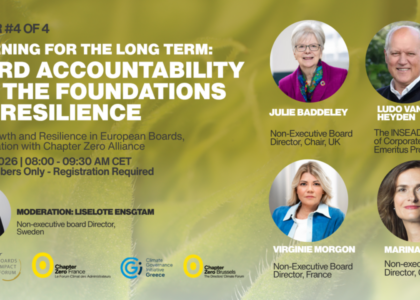
The fourth and final webinar in the series — Governing for the Long Term: Board Accountability and the Foundations for Resilience — takes place on 16 June 2026.
A collaborative initiative by Boards Impact Forum, Chapter Zero Netherlands, Chapter Zero France, Chapter Zero Brussels and Climate Governance Initiative Greece — part of the Chapter Zero Alliance.




Recent Comments