

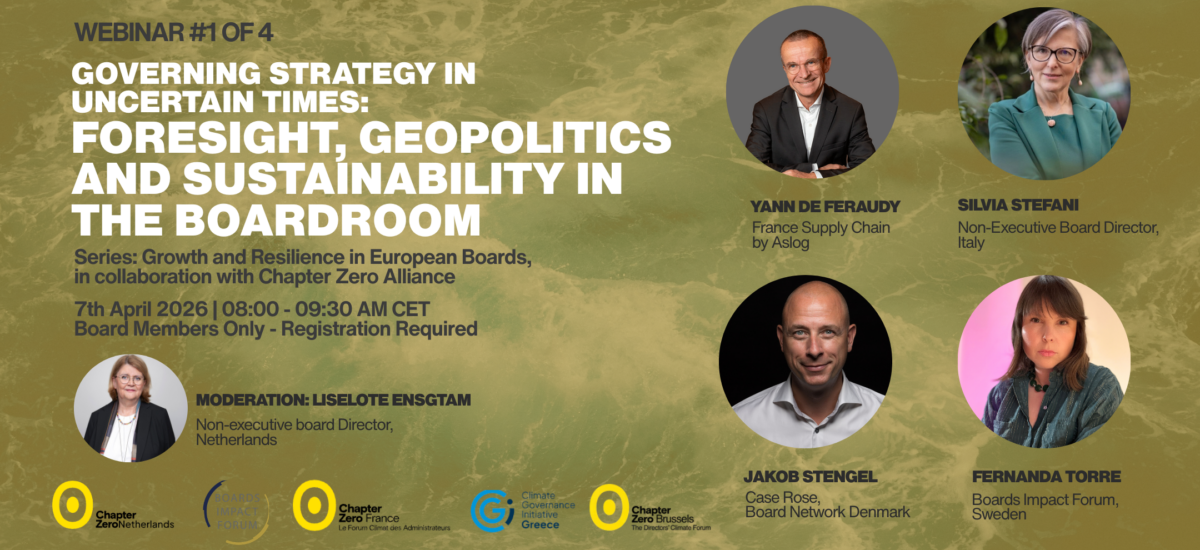
On the 7th of April 2026, Boards Impact Forum and Chapter Zero Netherlands co-organized a webinar with Chapter Zero France, Chapter Zero Brussels, and Climate Governance Initiative Greece, part of the initiative European Boards Growth and Resilience Roadmap, which aims to translate Europe’s most pressing governance challenges into practical board action.
As Europe’s competitiveness increasingly depends on how well boards govern the intersection of climate, geopolitics, and technological transformation, this initiative uses the Chapter Zero Alliance principles to build a shared European Boards Roadmap for Growth and Resilience — equipping directors across the continent to lead with clarity at the intersection of risk and opportunity.
Table of Contents
European Boards Are Facing Increasing Risks Ahead
That was the sobering conclusion of a webinar bringing together board directors and governance experts from across Europe to examine how boards can navigate an era of simultaneous geopolitical disruption, technological acceleration, and climate risk.
The session, organised by Boards Impact Forum together with Chapter Zero Netherlands and with support from Chapter Zero France, Chapter Zero Brussels, Climate Governance Initiative Greece, Chapter Zero Italy, and Chapter Zero Ireland, drew on fresh data from the world’s largest global board director survey, live polling of participants, and direct experience from non-executive directors working across energy, financial services, aerospace, and supply chain management.
The findings were clear: boards know which risks are coming. The gap lies in their readiness to govern them.
Why This Session, Why Now
This webinar didn’t happen in isolation. It is the first in a series of four webinars forming part of an exciting new initiative: the European Boards Growth and Resilience Roadmap, with support from the Chapter Zero Alliance.
The roadmap starts from a straightforward premise: Europe’s competitiveness in the coming decade will be determined, to a significant extent, by how well boards govern the intersection of climate risk, geopolitical disruption, and technological transformation. Boards are not passive observers of these forces — they are the strategic decision-makers who must respond to them.
The roadmap is being developed by Boards Impact Forum together with the European chapters of the Chapter Zero alliance, translating the alliance’s guiding principles for climate and nature in the boardroom into a concrete, actionable framework. The goal is not just to identify what boards need to do — but also what conditions need to be in place for boards to do their work well.
The process will run through 2025 in four stages: four webinars building shared understanding and surfacing challenges, a survey running in parallel, a face-to-face working session in Amsterdam (expected 7 October), and a final roadmap to be workshopped and tested across European chapters before publication.
Today’s session focused on the strategy principle — specifically, how boards can oversee the systemic integration of climate, nature, and geopolitical risk into long-term organisational strategy and capital allocation.

The Central Problem: Boards Know What’s Coming — But Aren’t Ready
Jakob Stengel, Chair of the Danish Professional Directors Association, opened with data from the world’s largest global board director survey — 3,416 respondents across 84 countries, gathered in January and February 2025 and not yet publicly published.
The findings confirmed a pattern that has now repeated every year for 14 years: the risks boards identify as most significant are precisely the areas where they feel least competent. AI, geopolitical instability, and trade disruption top the list of expected mega trends. They also sit at the bottom of board competency self-assessments — alongside innovation, cyber risk, and supply chain management.
“They know what could hurt them. But they are not yet ready to govern it.”
What has changed is not the gap itself — it’s the speed and simultaneity of the risks arriving at once. As Jakob put it: “We are no longer governing a stable system. We have to govern while the system itself is fragmented.”
The best-performing boards in the survey share four practices that set them apart: they treat board composition as strategic infrastructure, mapping competencies against their actual strategic challenges; they govern AI at board level rather than delegating it to IT; they institutionalise geopolitical intelligence and scenario planning into their regular agendas; and they actively maintain strategic optionality — treating scenario work not as a risk-mapping exercise, but as a way to uncover the opportunities hidden inside disruption.

Where to Turn for Geopolitical Intelligence
For board directors who cannot join a study trip, Jakob was specific about where to go for high-quality geopolitical analysis. For rigorous, well-sourced reporting he recommended Chatham House (the London-based think tank known for its diligent international affairs research), and for a more continental European perspective, the Bruegel think tank and the World Economic Forum, which between them cover strong political and economic ground. The Eurasia Group, though American, has a strong European focus. Closer to home, Jakob pointed to the ministries of foreign affairs in each country as an underused resource — particularly in the Nordic region, where Norway, Sweden, Finland, and Denmark all publish strong analysis on defence and security. His broader point: filtered news, social media, and even quality outlets like The Economist are not sufficient for the depth of geopolitical understanding boards now need. Firsthand experience and primary sources are what separate boards that are genuinely prepared from those that merely feel informed.

Sensing, Pivoting, Aligning: A Framework for Dynamic Boards
Fernanda Torre, Operations Director of Boards Impact Forum and co-author of AI Leadership for Boards, introduced the research framework underpinning the roadmap project — developed together with Lisa Loenstein, Henrik Forzel, and Professor Ludo van der Heyden of INSEAD, and published in the Journal of Risk Management in Financial Institutions in 2024.
The framework identifies three dynamic capabilities boards need: sensing (building the board’s own independent insight into the environment), pivoting (making strategic decisions and leading renewal), and aligning (allocating resources to follow through on those decisions).
The session focused on sensing — and on a critical distinction. Most boards do work with scenarios. But they receive pre-digested scenarios from management and approve them. That is a fundamentally different capability from the board actively developing its own foresight. “There’s something about just getting information that is already digested — the richness of possibilities gets lost. Boards should have the sensing capability themselves.”
Fernanda illustrated this using the futures cone: a model in which probable, plausible, possible, and even preposterous futures fan out from the present. The challenge today is that the edges of the cone — once considered fringe — are increasingly the futures actually unfolding. Scenario thinking is the discipline that helps boards navigate this: not forecasting (which assumes a known trajectory) and not visioning (which projects a desired destination), but the structured exploration of deep uncertainty.
A Tension Worth Watching: Some Signals
Fernanda flagged an emerging boardroom risk that sits at the intersection of geopolitics and technology. Europe relies on non-EU providers for over 80% of its digital products. In cloud infrastructure alone, Amazon, Microsoft, and Google account for around 70% of the European market.
This is creating a growing “kill switch” risk — what happens when a geopolitical rupture leads a US provider to restrict services to a European government or company? Several European public institutions have already begun acting on this concern, with a German state and municipalities in Denmark removing Microsoft products from public infrastructure. The European Parliament has voted on a memorandum on technological sovereignty and digital infrastructure in response.
At the same time, EU regulators are issuing record GDPR fines even as the legislative framework may be softening. Boards are navigating a moment where the rules may get looser while enforcement intensifies.

The Supply Chain Wake-Up Call
Yann de Feraudy, a non-executive director with deep expertise in supply chain resilience — and a background that began on a French nuclear submarine — offered the session’s most pointed challenge.
On a submarine, contingency procedures are rehearsed every week, and the rule is simple: things that haven’t been exercised do not exist. Yann’s question for boards: when did you last actually exercise your plan B? And did you exercise it with your entire ecosystem — your suppliers, your logistics partners, your digital infrastructure providers?
The lesson of both COVID and the ongoing Red Sea disruption is that everybody had the same plan B. When CMA CGM and others pivoted simultaneously to alternative overland routes through the Middle East, the capacity constraints became immediately apparent. The same logic applies to cybersecurity: a simulation that only involves internal teams is not a real test.
“Business continuity planning is not an individual sport. It is an ecosystem sport.”

From Reactive to Resilient: The Board’s Strategic Role
Silvia Stefini, an independent NED with board experience across energy, aerospace and defence, and banking, observed that the dominant mode on most boards has been reactive — risks are addressed as they arrive. What changes this is dedicated time: special board sessions outside the normal governance cycle, structured to challenge assumptions and explore alternative futures.
She also made a point with direct implications for European boards: the companies and countries least impacted by today’s energy price shocks and geopolitical instability are those that invested in energy transition earliest. Resilience to geopolitical risk and progress on climate strategy are not in tension — they are the same thing.

What Participants Said: Live Poll Results
Three questions were put to participants live:
Does your board integrate climate and nature into strategy and capital allocation? Around 60% responded neutral or disagree — a significant result even in a room of engaged board directors.
Is your board proactively engaging in scenario thinking — not just approving management’s scenarios? Again, a very small fully agree, with the majority neither sensing independently nor stress-testing scenarios themselves.
Is your board proactively monitoring key strategic dependencies? Around 46% agreed — but Jakob’s assessment was direct: boards tend to overestimate how well they’re doing here. Most have plan Bs for the major nodes of their supply chains but not for the full picture. “A very small part taken out of a wheel — the wheel still won’t keep going around.”

Watch the Recording & Read the Full Transcript
What Comes Next
The second webinar in the European Boards Growth and Resilience Roadmap series takes place on 23 April. Registration is open now.
The full series will culminate in a face-to-face working session in Amsterdam, expected on 7 October 2025, where participants will work together to draft and test the roadmap itself.
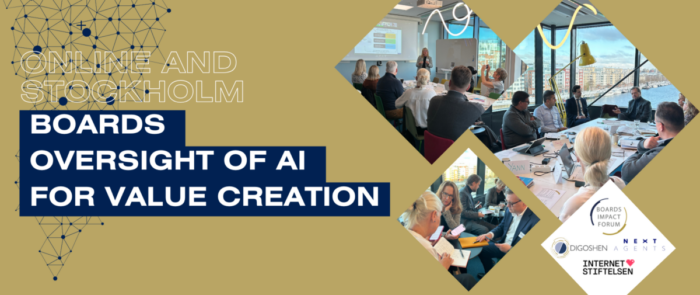
Boards Impact Forum is also currently opening the next cohort of its AI Leadership for Boards programme, with an early bird discount available. The programme includes a full day in Stockholm on 23 June.
If you have experience with scenario thinking at board level and would like to contribute to the scenario training programme currently under development, please get in touch directly.

Ready to lead your board through the AI and green transition?
Join our Boards Oversight of Responsible AI for Value Creation program and gain the tools, frameworks, and peer insights to turn disruption into strategic advantage. Register today and future-proof your board’s impact.
Become a Member
Want to be part of the transition? Become a member of Boards Impact Forum and shape the future of governance.

Recent Comments