


On 7 October, more than 75 non-executive directors and supervisory board members from across Europe, nearly 80 participants in all, met at Royal Schiphol Group for the European Boards Growth & Resilience Forum. Boards Impact Forum and Chapter Zero Netherlands hosted it, in partnership with the Chapter Zero Alliance.
The room reflected the diversity of Europe’s boardrooms. Participants came from more than 15 countries, from Poland and Greece to Ireland and the Nordics, and were split almost evenly between two-tier and one-tier board systems. Nearly a third came from financial services, alongside directors from professional services, manufacturing and industry, energy and utilities, technology, health and transport. Between them, they oversee listed, private, state-owned and family-owned organisations. Nearly half hold three or more board mandates, and five in ten have more than a decade of board experience.
The Forum was the culminating moment of a longer journey: four webinars and a pan-European board survey on how supervisory boards govern the intersection of sustainability, digital transformation and geopolitical change. Behind it sits a conviction shared across the Alliance’s European chapters. Corporate boards are one of the most powerful, and most underused, levers for driving Europe’s sustainability transition at scale. That happens not through compliance but through strategic leadership, and not by running sustainability as a parallel ESG agenda but by embedding it in how companies govern strategy, capital allocation and innovation.
Table of Contents
Why now: one transition, not three
Europe’s strategic context has fundamentally changed. The stability that shaped European growth for decades, anchored in globalisation, predictable geopolitics and steady economic integration, is giving way to a more fragmented and uncertain world. Rising tensions, shifting alliances and new forms of hybrid disruption are redefining security and economic relations.
At the same time, climate and nature impacts are no longer future risks. Extreme weather, resource constraints and disrupted infrastructure and value chains are already affecting Europe’s economies, and climate change increasingly acts as a multiplier of systemic risk. Meanwhile, slower productivity growth, high energy costs, strategic dependencies and underinvestment in key technologies such as AI are putting pressure on Europe’s industrial base.
These pressures are often treated as separate agendas. In reality, they converge, in disrupted supply chains, shifting markets, accelerating regulation and new expectations from investors and stakeholders. Europe is undergoing a triple transition:
- A green transition, reshaping energy systems, value chains and resource use
- A digital and technological transition, transforming productivity, business models and decision-making
- A defence and sovereignty transition, redefining security, resilience and strategic autonomy
These transitions reinforce and constrain each other. The same investments, capabilities and strategic choices increasingly determine outcomes across all three. For boards, overseeing risk in silos, or treating sustainability, technology and geopolitics as separate topics, is no longer enough. Boards must govern across the triple transition: understanding interdependencies, navigating trade-offs and identifying opportunities that strengthen both resilience and competitiveness.
That also means moving beyond compliance. Jaap Winter, Chair of the Supervisory Board of Royal Schiphol Group and host of the day, put it sharply: “The core risk of compliance is that it is not just the bottom but immediately becomes the ceiling.” The question is not what the rules require, but what leadership demands.
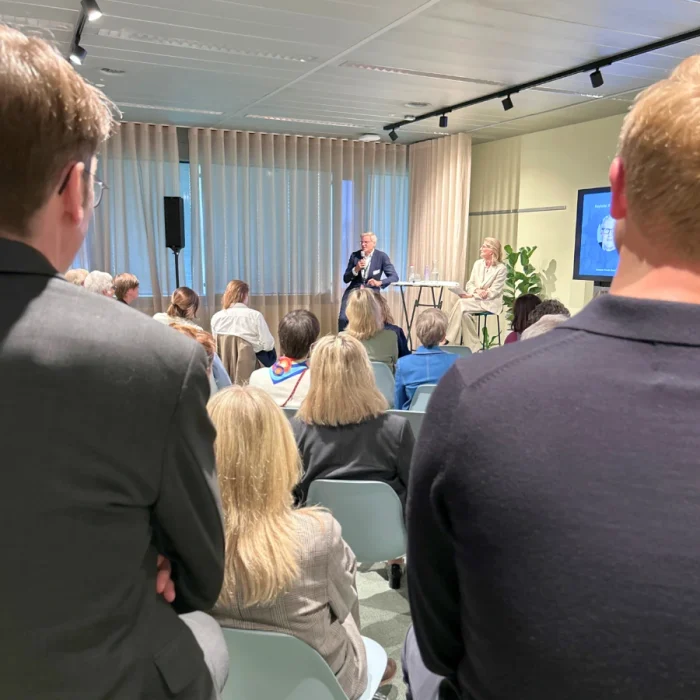
The European Boards Growth & Resilience Roadmap responds to this need. Building on the Chapter Zero Alliance principles, it brings board members from across Europe together to explore how governance must evolve, and to translate that into practical, board-level action. Amsterdam was the culminating moment of a journey that included four webinars and a pan-European board survey, driven by a shared conviction: boards are one of the most powerful, and most underused, levers for Europe’s transitions.
Pillar 1: Governing without naivety
The day’s first pillar explored how closely Europe’s green transition is tied to its geopolitical situation. Sustainability work often brings additional risks to the surface, from energy dependencies to fragile supply chains, and these cannot be governed in isolation. Energy security, sovereignty and defence now belong on the same agenda.
Moderator Marguerite Soeteman-Reijnen brought this into the room through Jeppe Kofod, former Danish Minister for Foreign Affairs and Chair of the Supervisory Board of Ukrenergo, Ukraine’s national grid operator. Kofod has argued publicly that “there is no European competitiveness strategy without energy security.” His account of governing critical infrastructure under sustained attack made the point vivid. In 2022, Ukrenergo synchronised with the continental European grid in three weeks, something that took the Baltic states well over a decade. On his board, crisis is no longer a separate agenda item; risk and operations are one conversation, and scenarios and spare equipment matter more than the ten-year plan.
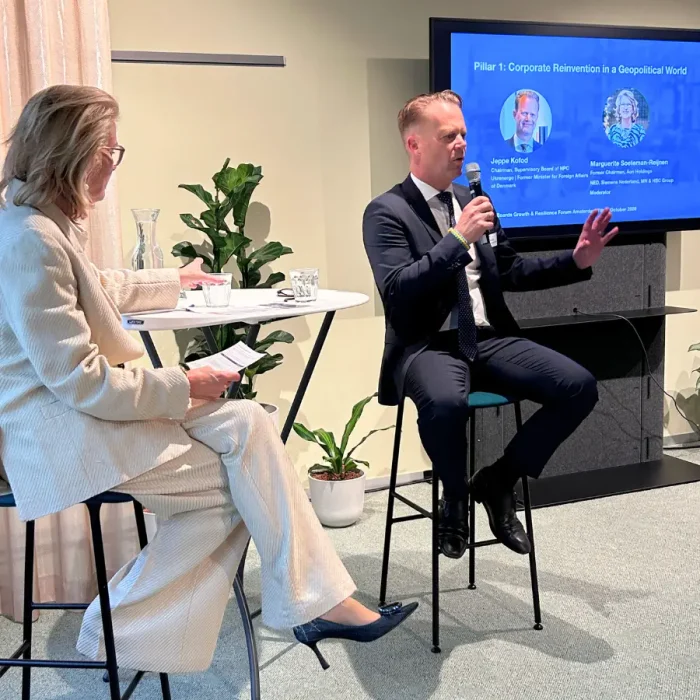
His advice was deliberately practical. Start with the one external factor that could disrupt your business: a loss of power, your most critical supply chain, a single key supplier. Then ask honestly what mitigation you have in place if it happens. Geopolitics can feel abstract, he noted; the board’s job is to translate it into concrete questions about its own business.
Ukrenergo’s own approach shows what that looks like. Rather than trying to make every asset invulnerable, which would mean burying the grid underground over decades, the company focuses on recovery. Critical transformers have physical protection, spare equipment is sourced and stockpiled through partners in Europe, the US and Japan, and the board asks a simple question: if a site is hit, how fast can it be back in service? Cybersecurity has been a priority since 2014, with redundancy built in throughout. For the board, the lesson is to keep plans flexible and protect management’s room to act as conditions change.
Marguerite brought the lesson home. In the Netherlands, much of which lies below sea level, a prolonged blackout could stop the pumps that keep the water out, and last year’s Iberian blackout showed such events are not hypothetical. Every director’s risk landscape is different, but the discipline is the same. Drawing on her career in insurance, she recalled that no one’s maximum-loss models had included anything like 9/11. Thinking in extremes, even scenarios that feel exaggerated, is how boards uncover what they would otherwise miss.
The conversation then moved into roundtables, where directors took up the strategic questions raised on stage: where are boards least prepared for a more uncertain and interconnected environment, does the board have the foresight to govern the triple transition proactively, and what should be done differently? Their insights will feed directly into the Roadmap. Three directors reported back to the plenary:
The conversation then moved into roundtables, where directors took up the strategic questions raised on stage: where are boards least prepared for a more uncertain and interconnected environment, does the board have the foresight to govern the triple transition proactively, and what should be done differently? Jakob Stengel (Denmark), Anne Årneby (Sweden) and Gisella Eikelenboom (Netherlands) reported back to the plenary on behalf of their tables, and their insights will feed directly into the Roadmap.
Pillar 2: Capital and ownership
IfIf boards are a lever, capital is the fuel. The Draghi report named four structural barriers to European competitiveness: chronic underinvestment, fragmented markets, strategic dependencies and weak productivity growth. The second panel, with Sarah Russell, Krzysztof Dresler, Jolande Sap and Marina Niforos, asked what closing that gap requires from boards, and why it is about more than money.
- Marina Niforos (former board member at Growthfund, the Greek sovereign wealth fund, and Séché Environnement; President of Climate Governance Initiative Greece) drew on five years at the sovereign fund, created amid the debt crisis to reform a portfolio of state-owned companies. Sustainability began as a governance exercise. As chair of the nominations committee, she used the renewal of some 18 subsidiary boards to set literacy requirements for new directors, while frameworks and toolkits were rolled out to executives in parallel. Only when the two converged did strategy take hold. Her lesson: as a non-executive, change comes through influence rather than authority, and people come first.
- Jolande Sap (Supervisory Board member at KPN; NED at Renewi; Chair of the Supervisory Board of the University of Amsterdam) said that for many companies, simply doing no harm is already hard work, but boards should aim higher. At KPN, the board invited the scientists behind the Future Proof Index, developed with Erasmus University, to show where the company creates and destroys value. A company is future-proof when its total value, financial, social and ecological, exceeds its financial value alone. By the second report, management was asking the researchers for help itself. She also argued for a quadruple transition, with a social transition alongside the other three, and invited companies to pilot citizen assemblies for business. Her experience at Renewi showed the limits of capital alone: the waste-to-product company had strong prospects, but delayed regulation on recycled content kept the business case waiting, even after it was taken private by long-term infrastructure and pension investors.
- Krzysztof Dresler (Vice-President of the Management Board, PKO Bank Polski) walked the room through the banker’s logic. Loan repayment depends on the quality of a company’s revenues, revenues depend on its position in the supply chain, and supply chains increasingly penalise carbon exposure. That makes credible transition plans a matter of credit risk, not regulation, and banks now build step-by-step roadmaps with clients by sector. But banks finance predictable cash flows; equity finances uncertainty. Europe holds around €10 trillion in bank deposits, yet compared with the US it has a major gap in early-stage risk capital.
- Sarah Russell (Supervisory Board member at ABN AMRO; Vice-Chair of the Supervisory Board of APG Group) recalled a Dutch investment institution created by pension funds and insurers after the financial crisis. It discovered there was no lack of liquidity, only a repricing of credit, and pivoted towards the transition. It closed after four years because it could not find enough unaddressed financing gaps: promising projects, such as a heat network for the Port of Rotterdam, were simply not bankable yet. Her lesson was additionality: public and private actors must stand side by side. For boards, the advice is practical. Know what kind of capital you need, get help packaging it, and listen to what counterparts say it will take to close the deal.
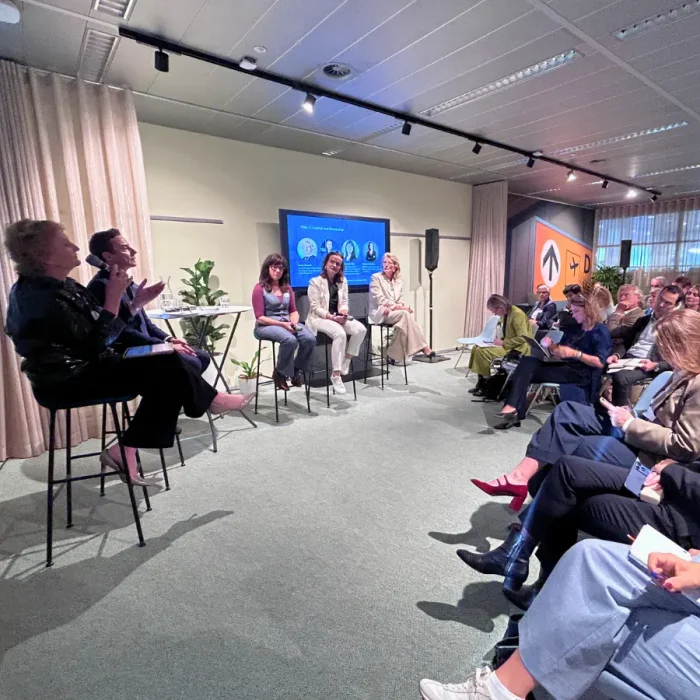
Marina Niforos closed the panel with a broader challenge. A capital markets union has been discussed for twenty years, and late-stage rounds for European scale-ups are still largely funded by American capital. Mobile capital is welcome, she argued, but the terms of engagement should ensure European citizens share in the value created. Governance itself is under pressure too: frameworks that were stable for half a century are meeting an unprecedented convergence of fast-moving forces. Non-executives should bring their skills to management more often and more constructively, without taking over execution.
Directors’ live self-assessment on a 1–5 scale was sobering. They gave 2.5 for alignment with owners on long-term direction and investment, 2.9 for deciding for the long term under short-term pressure, and 2.6 for allocating capital across the three transitions as one connected challenge.
Directors then took these questions into roundtables, whose insights will feed into the Roadmap. After lunch, Bente Sollid (Norway), Francesco Burelli and Henrik Forzelius (Sweden) reported back to the plenary on behalf of their tables.
Pillar 3: The board of 2030 and the AI blind spot
ThThe final panel, moderated by Steen Buchreitz Jensen with Gervaise Slowey, Umberto Malesci, Liselotte Engstam and Professor Ludo Van der Heyden of INSEAD, looked ahead. It surfaced a blind spot few boards have addressed: AI is no longer only a technology question. It is fast becoming an energy, infrastructure and sustainability question.
Data-centre electricity demand is surging, with direct consequences for grids, energy dependencies and emissions. Liselotte Engstam, Chair of Boards Impact Forum, framed the risk: when boards decide on AI without looking at its sustainability repercussions, “you are probably not accounting for the full cost of that decision.” Are AI strategy and sustainability commitments decided in the same conversation, or in committee tracks that never meet?
There is a social dimension too. AI is reshaping labour markets at a speed most organisations are not yet governing, which echoed Jolande Sap’s call to treat the social transition as core board business.
Each panellist then sketched what the board of 2030 will need to be:
- Gervaise Slowey (NED at Dalata Hotel Group, Molten Ventures and Wells Fargo Bank International) argued that sustainability endures only where it is tied to commercial value; seen purely as risk and compliance, it fades fast. Years of reporting and accreditation work have had benefits, but they have also distracted many boards from the real decarbonisation opportunity, estimated at around €1 trillion in Europe alone. She gave two examples from a hotel group: energy retrofits and LED conversions treated as ordinary capital projects with clear payback, and significant contracts won on the strength of evidence-based sustainability action. On AI, she was clear that humans remain fully accountable. AI cannot be a shadow director, carry fiduciary duty or bring lived moral experience to a decision. It is also too big to leave to one director: the whole board needs enough literacy to challenge assumptions, a policy of mandatory human oversight, and the “digital humility” to admit what it does not yet know.
- Umberto Malesci (independent director at Assicurazioni Generali) moved from governance of AI to governance with AI. Management already uses AI to prepare board papers, and directors increasingly use it to analyse them, surfacing red flags and sharper questions. The traditional information gap between executives and non-executives is shrinking, and directors are becoming more demanding. That raises a provocative question: if agents can exchange information before the meeting, what is the meeting for? His answer: the uniquely human act of taking responsibility and deciding on limited information about an uncertain future.
- Liselotte Engstam (Chair of Boards Impact Forum; board roles at Tietoevry, Zalaris and Transtema) framed the agenda for chairs in three words: more proactive, putting the right issues on the agenda; more capable, through deeper and continuous education rather than recruitment alone; and more dynamic, finding new ways of working such as temporary committees. She challenged every board to decide what it should stop doing, start doing and redesign, and asked each director: if you still want a board seat in 2030, what will you add that is uniquely human?
- Ludo Van der Heyden (Insead Professor, Chair of Seisquare; former supervisory board member at Naftogaz of Ukraine) predicted that as execution becomes increasingly automated, governance will emerge as the defining human activity, yet it remains poorly understood. Boards need a shared vocabulary and a clear distinction between business strategy, owned by executives; ownership strategy, set by investors; and board strategy, which is how owners, executives and boards together shape corporate strategy. Nothing is ever simply “sustainable”, he noted; every company is on a journey of transformation, and responsibility for where it leads rests with the board. He urged boards to keep refreshing their own composition, connect beyond the boardroom, collaborate at industry level where many solutions lie, and engage constructively with EU policymaking.
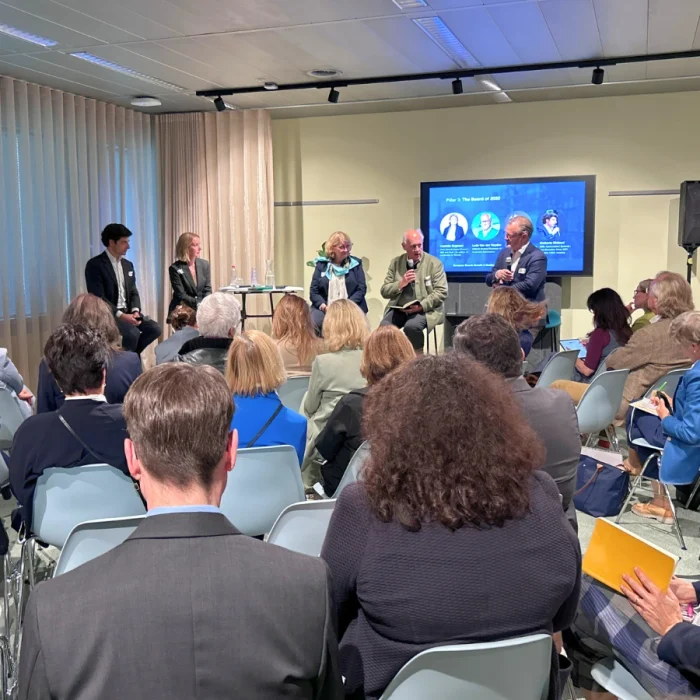
The live self-assessment showed how much work lies ahead. On a scale of 1 to 5, directors rated their boards around 2.9 for having the right people, priorities and ways of working for the challenges ahead, and just 2.8 for continuously building capabilities in AI, sustainability and geopolitics.
The final roundtables took up the panel’s questions: how sustainability and AI can become core levers for growth, and what boards must stop, start and redesign. Anne Marie Verstraeten (UK) and Alan Duffy (Ireland) reported back to the plenary on behalf of their tables, and these insights, too, will feed into the Roadmap.
Closing interview: from decision to choice
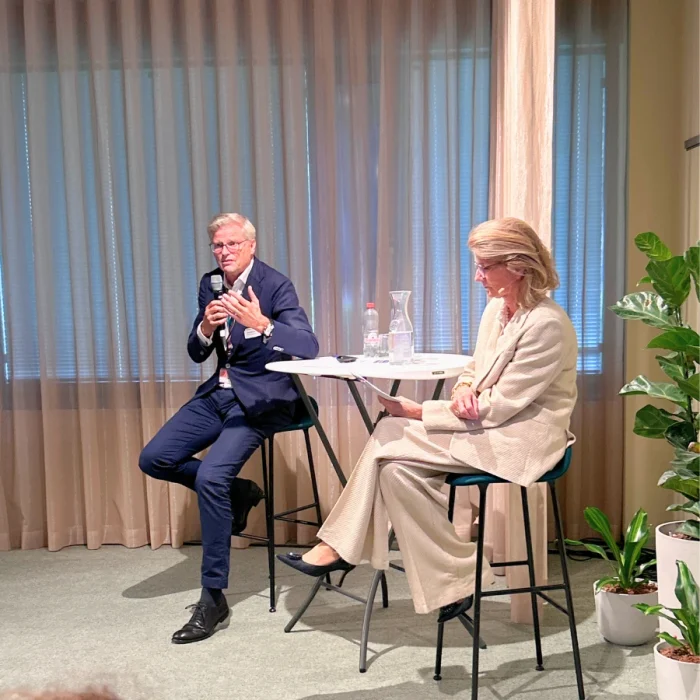
The final session brought Marguerite Soeteman-Reijnen into conversation with our host, Jaap Winter, Chair of the Supervisory Board of Royal Schiphol Group. It was the moment that brought the whole day together.
Jaap began with a distinction between decision and choice. At the level of decision, the immediate consequences of fundamental transformation will always say “don’t”, or “only once governments, competitors and the whole supply chain have moved first”. Real change needs directors who, from personal conviction, choose to make a difference.
He shared his experience as chair of Schiphol. Just weeks into his role as chair, in the middle of the post-COVID crisis of summer 2022, the Dutch government announced it would cut flights by around 12% over noise concerns. The board chose not to fight it. Within its own control, Schiphol changed its tariffs so that the noisiest aircraft pay around ten times more at night, cutting night-time noise by about 30% within a year. Decarbonising aviation is a decades-long task no airport can solve alone, so Schiphol is building coalitions of the willing across airports, airlines, aircraft manufacturers and energy companies. “If we don’t start today,” he said, “it will take even more.”
His sharpest warning was about learned helplessness: boards feeling powerless before a system they believe they cannot change. “We’ve made the system ourselves,” he reminded the room. “And if the system is made by us, we can also change it.” Responsibility, he argued, should be embraced as a source of strength, not fended off through compliance and risk management.
Asked for his advice to the directors in the room, his answer was simple: “Please go home and be courageous.” He added that resilience, freeing Europe from its fossil fuel dependencies, will be the biggest driver of decarbonisation over the next decade. Sustainability only appears to conflict with resilience and competitiveness when boards push problems into the future or externalise them onto governments and others. Embraced, it generates both.
He ended with a call that goes to the heart of this initiative. Non-executives now shape company direction far more than they did 25 years ago, and it is their role to hold the long term in view while executives are absorbed by the here and now. Yet when business speaks in Europe, it is executives and business associations that are heard. Non-executives, he argued, should find ways, modestly and humbly, to bring their long-term perspective to regulators and policymakers. As Marguerite concluded, organised collectively across Europe, that voice would be stronger still.
What comes next: a roadmap and a community
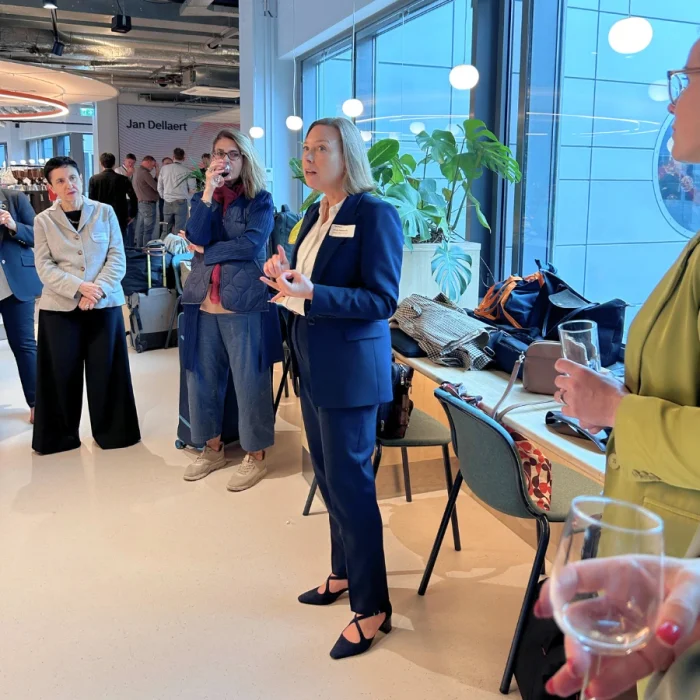
The day closed over networking drinks at Schiphol, where Emily Farnworth, CEO from the Chapter Zero Alliance, reminded the room that Amsterdam is part of something much larger. The Alliance has grown into a global network of board director communities in more than 70 countries, working to make effective climate and nature governance the norm in every boardroom, and its momentum shows no sign of slowing.
The insights from Amsterdam will now shape the European Boards Growth & Resilience Roadmap: a board-led agenda of practical governance actions for renewal, resilience and competitiveness. Its ambition is to give Europe’s non-executive directors a collective voice, grounded in what they see in their own boardrooms, on how Europe can turn its transitions into lasting strength. The Roadmap will launch in February 2027, just after Davos, as the year’s agenda moves from conversation to action.
But the ambition is bigger than a document. As Sylvia Robben, Executive Director of Chapter Zero Netherlands, put it, the aim is to build “a European community of board leaders who have made the choice, personally and collectively, to govern for the long term.” Amsterdam showed that community already exists. The work now is to make it count.
Looking Ahead
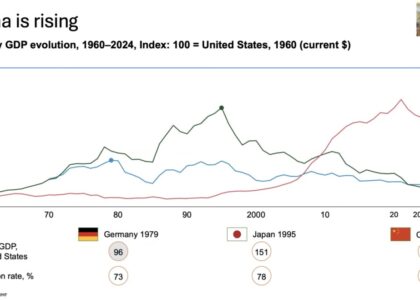
The webinar’s core insight was stark: European boards understand the China challenge intellectually, but lack the frameworks and execution velocity to respond strategically. Two initiatives address this gap directly.
First: Board Oversight of Responsible AI for Value Creation
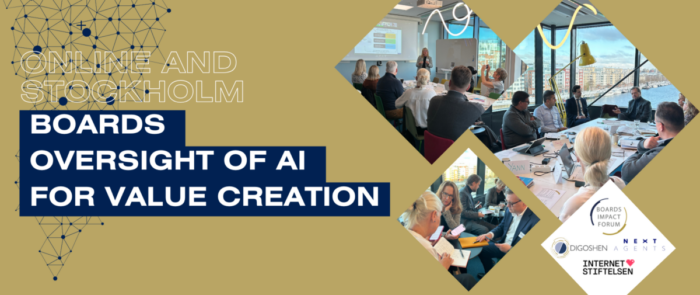
If the China challenge is fundamentally about systems integration and execution speed, then understanding AI—not as a productivity tool, but as a driver of industrial transformation, infrastructure costs, and competitive velocity—is no longer optional for boards.
Boards Impact Forum has. anew cohort for the Board Oversight of Responsible AI for Value Creation program, a research-based training designed specifically for non-executive directors. Built on the book AI Leadership for Boards (published by Springer Nature in collaboration with Chalmers University of Technology, Stockholm School of Economics, MIT CISR, and INSEAD), the program equips directors with the strategic questions, frameworks, and systems thinking required to govern AI investment and risk at the speed the market now demands.
The program combines 7 online modules (26 lessons, approximately 24 hours) with three live webinars and AI-powered boardroom simulations that recreate realistic governance scenarios. One module is specifically designed to be completed jointly with your management team, creating shared language and alignment on AI governance between board and C-suite.
Program dates:
- Registration deadline: 24 October 2026
- Webinar 1 (Boards as AI Enablers): 29 October, 08:00–09:30 CET
- Webinar 2 (Boards Supervision of AI): 11 November, 08:00–09:30 CET
- Webinar 3 (Boards Leading Strategic Ambition): 3 December, 10:00–11:30 CET + optional full day in Stockholm
Pricing: €2,450 + VAT thereafter. Registration and more details: fernanda.torre@boardsimpactforum.com. Attendees of the European Forum have a special 30% discount, avaialble on the agenda document, reach out to us if you need the code.
Upon completion, you join an international alumni community of certified board leaders—continuous access to the learning platform, ongoing peer exchange, and regular events.
If your board wants to move from discussing AI strategy to actually implementing it—and doing so at the execution speed that Chinese competitors are already demonstrating—this program closes a critical gap.
Second: Governing Under Conflict and Attrition
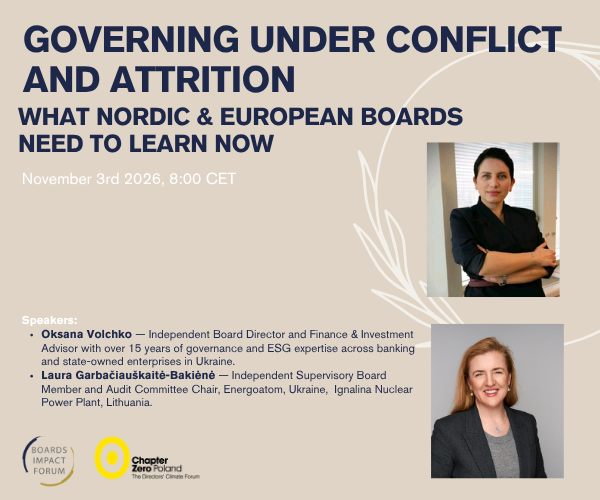
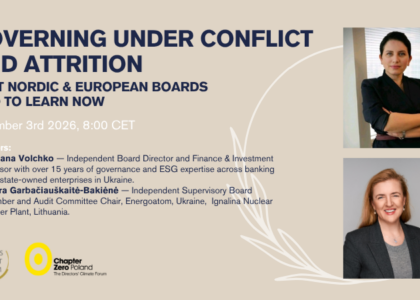
On 3 November 2026 (08:00–09:30 CET), Boards Impact Forum and Chapter Zero Poland will co-host Governing Under Conflict and Attrition: What Nordic & European Boards Need to Learn Now.
This webinar brings together board directors with direct, first-hand experience of governing under conditions of active conflict and active preparedness—from Ukraine’s frontlines to the Baltics—to explore what practical governance lessons Nordic and European boards should be drawing now, before they need them.
Speakers include Laura Garbačiauškaitė-Bakiėnė, Independent Supervisory Board Member and Audit Committee Chair at Energoatom (Ukraine’s national nuclear energy company), and Oksana Volchko, an experienced non-executive director with 15+ years of governance expertise across banking, state-owned enterprises and the CEE region. The discussion will address how supervisory boards can govern critical infrastructure under conditions of physical threat and cyber attack, maintain strategic direction when the future is fundamentally uncertain, and build board-level resilience capabilities in an era of expanding hybrid threats.
This webinar is reserved for board directors and those holding a board mandate, ensuring a frank and focused peer-level exchange. To register, please confirm your active board mandate.


Recent Comments