

On 18 September 2026, board directors and governance leaders gathered for a webinar co-hosted by Boards Impact Forum and the Climate Governance Initiative Hong Kong Chapter to examine a question few European boards have adequately addressed: how is China’s industrial transformation reshaping global value chains, and what does that mean for European board strategy?
The conversation between Dr. Lola Woetzel (40 years of experience in China, McKinsey Global Institute) and Bente Sollid (Norwegian board director, recently returned from an intensive executive program in China) revealed both the scope of the disruption underway and the gap between what boards know they should understand and what they actually do.
Table of Contents
China’s Transformation: Historical Roots and Current Strategy
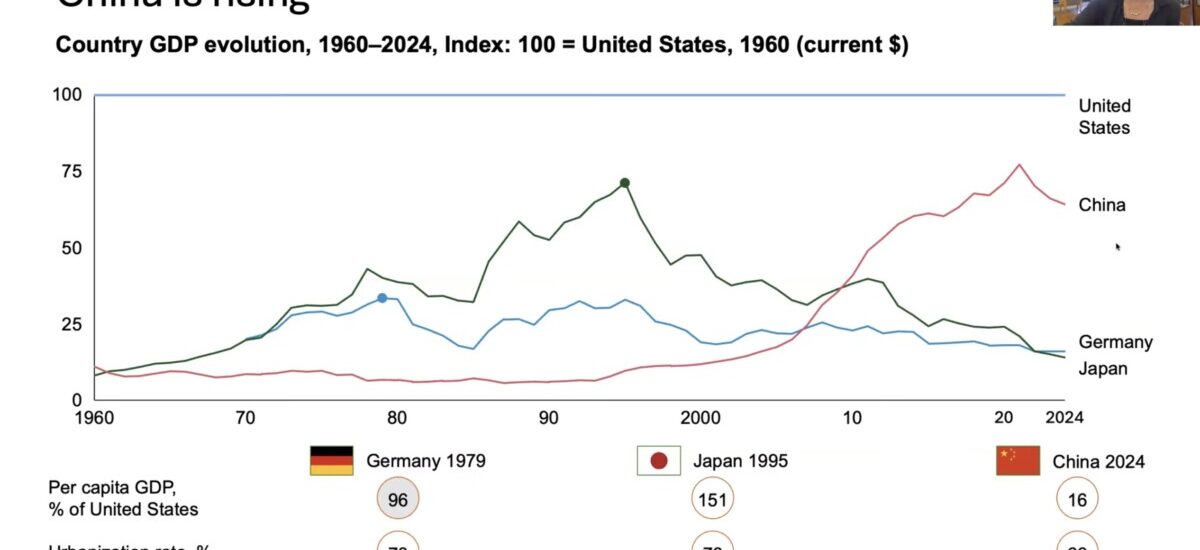
Woetzel opened with historical framing that recontextualized the entire discussion. China’s modern economic model, she argued, does not begin in 1978 with economic opening. It begins in 1840 with the Opium War—the moment when Western powers “kicked down the door.” That century-long experience of vulnerability shaped what followed: an deliberate strategy to build an independent, self-sufficient economic system that cannot be turned off by external powers.
The current results are striking. Chinese companies hold global leadership in sustainability-oriented sectors—solar, batteries, electric vehicles, advanced manufacturing—growing at 20-40% revenue rates while fundamentally restructuring value chains. But Woetzel was careful to distinguish what this actually represents. “This isn’t about copying,” she emphasized. It’s about disruption.
The automotive sector illustrates the pattern. Chinese companies did not attempt to compete against Europe and Japan in internal combustion engines—an area where they had repeatedly failed. Instead, they pivoted to electric vehicles, starting on an unfamiliar curve with high costs and low maturity, but betting that scale and speed would eventually drive costs below established players. Tesla validated the strategy; Chinese competitors are executing it at scale.
Disruption as Systems Integration, Not Component Innovation
This is where Sollid’s ground-truth reporting became essential to the conversation. She had just spent three weeks in China—Hong Kong, Shenzhen, Shanghai, Beijing—traveling not as part of a demonstration delegation but as a learner, visiting universities, research institutions including Huawei (100,000+ R&D staff, 22% of revenue spent on research and development), and advanced manufacturing facilities.
“I’ve been looking at the US to understand disruption,” she reported. “Today I don’t—I see that this view is just half the world.”
What struck her was not individual innovations or technical capabilities, but how everything connects. EV cars require batteries. Batteries require minerals, chemistry, advanced manufacturing. Manufacturing increasingly requires AI, robotics, precision design. AI requires chips, data centers, electricity. Electricity requires grids, storage, renewable energy infrastructure. The entire system is integrated—not in theory, but in practice, across connected value chains and end-to-end ecosystems.
“You see everything in China,” she said. “What I stopped thinking is that we discuss who has the best AI model. It’s not about model—it’s about the system.”
This observation cuts to what may be the core European blind spot. European boards debate whether the continent can build competitive AI models, whether it can match China’s innovation velocity. But the actual game, according to what Sollid witnessed, is ecosystem design. “China is building industrial transformation systems. Europe is optimizing individual components.”
Speed and Execution as Structural Advantage
Woetzel identified execution speed as a distinguishing structural characteristic. NIO iterates on complete vehicle models every six to 16 months; Tesla requires 24 months. That velocity compounds into cost efficiency—across solar, wind, batteries, and EVs, the cost curves show Chinese companies consistently pushing lower and faster.
Three structural factors enable this, she argued. First, a macro environment that supports speed: government backing for construction permits, zoning approvals, research funding—often decentralized rather than centralized, which matters for how systems actually get built. Second, end-to-end clusters rather than geographically dispersed value chains. China started as an outsourced manufacturing location, then systematically asked: what else can we do? What’s next to us? Over time, they built scaled, integrated ecosystems where you don’t need to cross borders to source components. Third, outcome-based accountability. When Chinese companies commit to targets, they hit them. Measurements are outputs, not inputs. This drives a delivery focus that permeates both private and government sectors.
Later in the session, Sollid would observe a related dynamic directly. She asked a vice CEO of one of China’s largest banks: “Aren’t you discussing regulatory risk? Ethical concerns? The problematic sides of AI?”
The response was direct: “Of course we are discussing. But we complete the discussions and then we execute. That’s the difference. You keep on discussing without executing.”
This wasn’t presented as recklessness—it was a different risk calculus. China discusses, identifies responsibility, concludes, then executes and manages risk in real time. Europe discusses, keeps discussing, and execution gets delayed by years.
The Ground Truth: What European Boards Are Missing
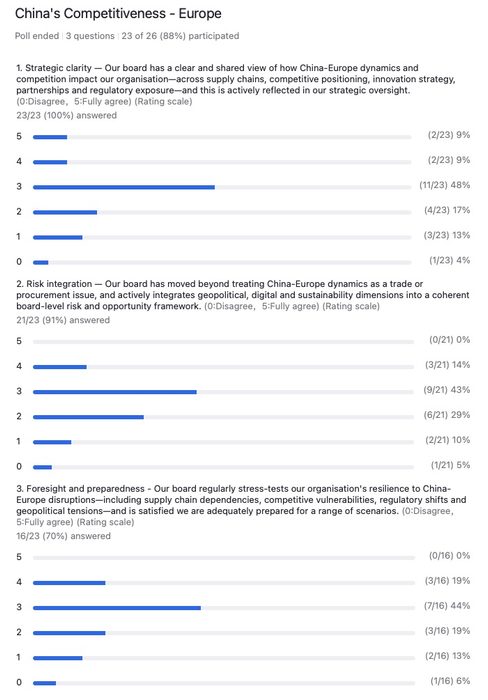
The webinar’s poll revealed the gap starkly. Asked whether their boards had defined clear accountability structures for managing China-Europe strategic dynamics, boards rated themselves as moderately prepared. Asked whether they had sufficient command of the subject to govern it effectively, confidence dropped notably. Asked whether they had adequate foresight and preparedness, the scores were lowest of all.
Sollid had already named the specific questions boards should be asking:
- Where in our value chain is China already changing the economics? Not whether China is a threat, but where are the currents shifting beneath your existing model?
- Why and where are Chinese competitors learning faster than we are? Speed of change is also a learning advantage. Chinese companies iterate, gather data, adjust. European companies plan, discuss, redesign.
- Which technologies and resources are critically dependent on China? Not as nationalistic anxiety, but as strategic assessment of where control matters.
- How can we learn from China without becoming strategically dependent on it? This is the genuinely hard question. Sollid didn’t want to travel with a Norwegian delegation designed to showcase Norway. She went to learn—from Chinese universities and professors, to visit facilities like Huawei, to see advanced manufacturing firsthand. European boards aren’t doing that work.

A Framework for Board Assessment
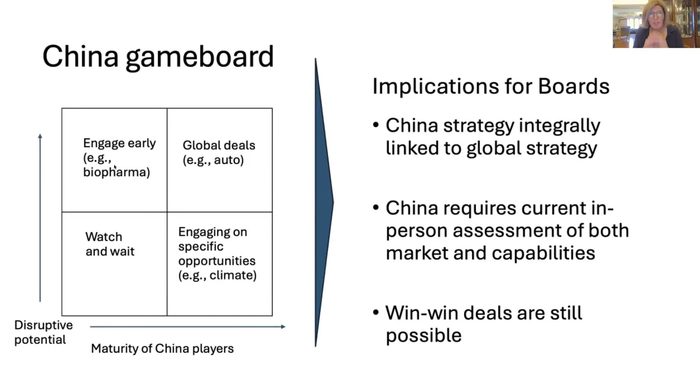
Woetzel presented a practical framework for assessing board strategy by sector, using a two-by-two matrix that maps where China sits in relation to disruption potential and the maturity of Chinese players.
The four strategic positions:
Global deals (high disruption, high maturity of Chinese players). Automotive exemplifies this quadrant. Chinese players are driving the disruption; there is no separate China strategy anymore—only a global strategy that is now Chinese-centered. European automakers like VW, Stellantis, and Daimler are essentially betting the company on their response.
Engage early (high disruption, low maturity of Chinese players). Biotech and pharmaceuticals sit here. Chinese companies are coming, but not yet dominant. One out of six molecules in major pharma pipelines now comes from China—an unsustainable position. Within 5-10 years, Chinese companies will enter the market directly and value chains will be rewritten. The window to engage strategically is open now.
Engaging on specific opportunities (low disruption, high maturity of Chinese players). Steel, chemicals, and climate-related sectors fall here. Disruption potential is lower in the near term, but strong strategic reasons to engage exist—climate collaboration, innovation partnerships, and capability building. Companies like ArcelorMittal and LanzaTech are finding ways to work with Chinese partners on carbon reduction.
Watch and wait (low disruption, low maturity of Chinese players). Some sectors still have time to observe and prepare before Chinese competition intensifies.
Board implications: China strategy is inseparable from global strategy. It requires current, in-person assessment of both market dynamics and Chinese capabilities. And crucially: win-win deals are still possible—but only for boards that understand where they sit on the gameboard and act accordingly.
What Participants Said: Live Poll Results
Three questions were put to participants:
Has your board defined clear strategic positions on China-Europe competitive dynamics? Results showed moderate preparedness, with roughly half of participants confident they had adequate strategic framing. The other half acknowledged gaps.
Does your board have sufficient understanding of how Chinese competitors are restructuring value chains in your sector? Results were notably less confident here—reflecting the complexity of tracking systemic industrial transformation across geographies.
Is your board prepared for the speed of execution you’re now competing against? Responses split significantly, with a clear cohort feeling under-prepared for the decision velocity required.
Woetzel closed with an assessment that challenges the status quo: “China is a full body experience. The only way boards will actually learn about China is to go to China and be in China.”
The boards that will navigate the next decade successfully are those that assess their position on Woetzel’s game board, build genuine understanding through direct engagement, identify where disruption will hit them first, and decide whether to compete, partner, learn, or strategically wait. Those that continue discussing the issue in Brussels and Stockholm—without grounding that discussion in ground truth—risk waking to a competitive landscape they did not see coming.
Looking Ahead
The webinar’s core insight was stark: European boards understand the China challenge intellectually, but lack the frameworks and execution velocity to respond strategically. Two initiatives address this gap directly.
First: Board Oversight of Responsible AI for Value Creation
If the China challenge is fundamentally about systems integration and execution speed, then understanding AI—not as a productivity tool, but as a driver of industrial transformation, infrastructure costs, and competitive velocity—is no longer optional for boards.
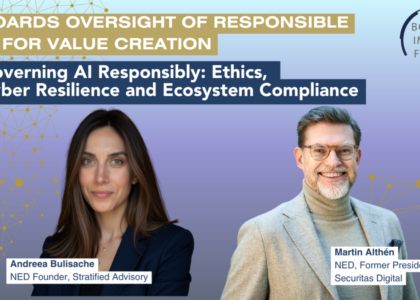
Boards Impact Forum is launching the Board Oversight of Responsible AI for Value Creation program, a research-based training designed specifically for non-executive directors. Built on the book AI Leadership for Boards (published by Springer Nature in collaboration with Chalmers University of Technology, Stockholm School of Economics, MIT CISR, and INSEAD), the program equips directors with the strategic questions, frameworks, and systems thinking required to govern AI investment and risk at the speed the market now demands.
The program combines 7 online modules (26 lessons, approximately 24 hours) with three live webinars and AI-powered boardroom simulations that recreate realistic governance scenarios. One module is specifically designed to be completed jointly with your management team, creating shared language and alignment on AI governance between board and C-suite.
Program dates:
- Registration deadline: 24 October 2026
- Webinar 1 (Boards as AI Enablers): 29 October, 08:00–09:30 CET
- Webinar 2 (Boards Supervision of AI): 11 November, 08:00–09:30 CET
- Webinar 3 (Boards Leading Strategic Ambition): 3 December, 10:00–11:30 CET + optional full day in Stockholm
Pricing: €1,715 + VAT (Early Bird, until 10 October using code EarlyBIFBird); €2,450 + VAT thereafter. Registration and more details: fernanda.torre@boardsimpactforum.com
Upon completion, you join an international alumni community of certified board leaders—continuous access to the learning platform, ongoing peer exchange, and regular events.
If your board wants to move from discussing AI strategy to actually implementing it—and doing so at the execution speed that Chinese competitors are already demonstrating—this program closes a critical gap.
Second: Governing Under Conflict and Attrition

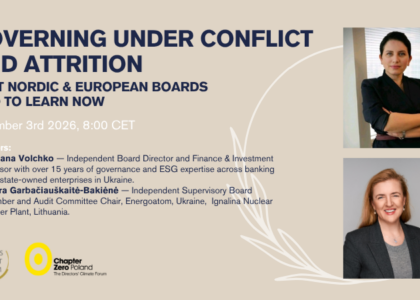
On 3 November 2026 (08:00–09:30 CET), Boards Impact Forum and Chapter Zero Poland will co-host Governing Under Conflict and Attrition: What Nordic & European Boards Need to Learn Now.
This webinar brings together board directors with direct, first-hand experience of governing under conditions of active conflict and active preparedness—from Ukraine’s frontlines to the Baltics—to explore what practical governance lessons Nordic and European boards should be drawing now, before they need them.
Speakers include Laura Garbačiauškaitė-Bakiėnė, Independent Supervisory Board Member and Audit Committee Chair at Energoatom (Ukraine’s national nuclear energy company), and Oksana Volchko, an experienced non-executive director with 15+ years of governance expertise across banking, state-owned enterprises and the CEE region. The discussion will address how supervisory boards can govern critical infrastructure under conditions of physical threat and cyber attack, maintain strategic direction when the future is fundamentally uncertain, and build board-level resilience capabilities in an era of expanding hybrid threats.
The timing is deliberate. China’s speed and systems integration are a long-term strategic challenge. But the immediate challenge many boards face is how to govern effectively when the operating environment is unstable, external shocks are constant, and board attention is fractured. This webinar equips directors with frameworks and real-world lessons for maintaining strategic focus and stakeholder trust under conditions that most European boards have never had to navigate.
This webinar is reserved for board directors and those holding a board mandate, ensuring a frank and focused peer-level exchange. To register, please confirm your active board mandate.



Recent Comments