


June 18, 2025 | Hosted by Boards Impact Forum and Scandinavian Executive Institute
As artificial intelligence transforms industries, markets, and business models, boards are increasingly expected to evolve from digital literacy to true AI-savviness. On June 18, Boards Impact Forum, in partnership with the Scandinavian Executive Institute, hosted a forward-looking webinar on how boards can lead confidently and responsibly in the age of AI.
Featuring groundbreaking research from MIT and Boards Impact Forum, as well as strategic insights from seasoned non-executive directors, the session highlighted both the challenges and opportunities boards face today.
Table of Contents
MIT Research – Digitally and AI-Savvy Boards Drive Performance
Stephanie Woerner, Director at MIT’s Center for Information Systems Research (CISR), shared compelling evidence from her latest research on board digital savviness. Her team analyzed U.S. public company board bios using natural language processing to assess digital and AI readiness.
- In 2019, only 24% of boards were considered digitally savvy. Those with at least three digitally savvy directors saw improved revenue growth, ROA, and market cap.
- In 2024, although 72% of boards showed digital savviness under legacy criteria, no performance premium was detected—suggesting a new baseline had been reached.
- By introducing a more stringent AI-savvy criteria (focused on AI, LLMs, platform thinking, etc.), only 26% of boards met the threshold—and these boards once again demonstrated a performance premium.
Woerner’s takeaway: Boards must constantly elevate their understanding of emerging technologies. Performance gains are now tied to deeper AI comprehension and strategic engagement.
“AI strategy is business strategy. Boards must balance business model risk with technological experimentation—and that requires the right mix of knowledge and governance.” – Stephanie Woerner

A Framework for Board-Level AI Leadership
Fernanda Torre, CEO of Next Agents and Operations Director at Boards Impact Forum, introduced an updated framework for AI leadership at board level—based on multi-year research with Chalmers University and INSEAD, and insights from the upcoming edition of AI Leadership for Boards.
The framework outlines three imperatives for boards:
- Set a Strong Foundation
Boards must evaluate their own readiness—including structure, competencies, and committee composition. A self-assessment matrix helps guide these reflections. - Balance Guidance and Supervision
- Guidance: Boards must actively steer AI-related innovation, data strategy, and business model evolution.
- Supervision: Oversight of AI ethics, regulatory compliance, cybersecurity, and partner ecosystems is crucial.
- Lead the Strategic Ambition
Boards must help organizations move beyond use cases toward business model transformation—aligning AI with sustainability, workforce shifts, and long-term purpose.
Torre emphasized the strategic advantage of combining AI and sustainability, calling it a “moat-building opportunity” for organizations ready to lead.

Panel Highlights: Real-Life Boardroom Experiences
Bertil Carlsén (CxO, Advisor, Board Chair) and Charlotta Nilsson (COO, Paradox Interactive; Board Member, Nordnet & Industrifonden) shared practical insights from their boardrooms:
- Triggers for AI Engagement: For many boards, the public launch of ChatGPT and internal incidents (like cyberattacks) were key turning points. Carlsén reflected, “I think it’s a fantastic thing we are in right now. Maybe the sort of technology inflection point was actually the launch of ChatGPT-4 to the public, because suddenly you could see, it was awareness that started it.”
- Common Blind Spots: Boards often mistake basic tech use for readiness. The biggest risks lie in assuming “we already do AI” without deeper evaluation.
- Strategic Risk Framing: Boards must not only assess risk levels but define where in the organization it is acceptable to experiment versus where strict governance is needed. Nilsson noted, “We underestimated the need for true technical and digital savviness. As directors, we must now set the tone for where experimentation is safe and strategically valuable.”

Poll Results: Boards Still Catching Up
Polls conducted during the session revealed a gap between aspiration and readiness.
Panelists and speakers agreed: true AI leadership demands board-level humility, ongoing education, and strategic foresight.
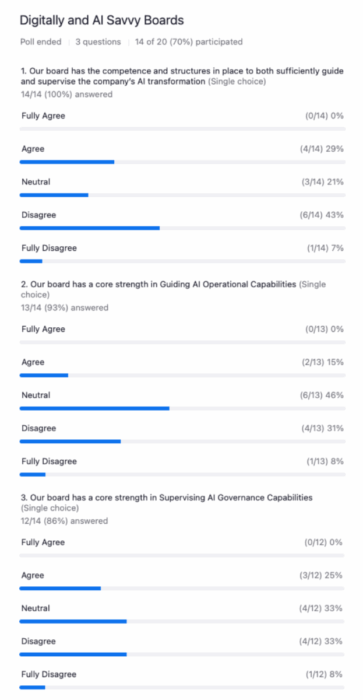
Few participants fully agreed that their boards had the structure and skills to guide AI transformation.
Most indicated stronger capabilities in supervising AI efforts than guiding them.
Learn More
At Boards Impact Forum, we remain committed to supporting NEDs in this evolving landscape, ensuring sustainability and governance go hand in hand.
Webinars, Peer Exchanges and Events
Check our upcoming events, all with NED Guest Speakers and Peer Exchange:
- June 26: The Future Boardroom – How to Transform in Turbulent Times
- September 4: Responsible AI Program – Early bird available through August 17
- September 25: Sustainability Program – Early bird available through August 17
Board Programs
Sign up for our programs:
- Boards Oversight of Sustainability – Early bird available through August 17
- Boards Oversight of Responsible AI – Early bird available through August 17
Become a Member
Want to be part of the transition? Become a member of Boards Impact Forum and shape the future of governance.
About Boards Impact Forum and the blogpost
Event arranged by Boards Impact Forum and Scandinavian Executive Institute.
This blogpost is also shared at the blog of of Digoshen, www.digoshen.com.



Recent Comments