

On the morning of 16 June 2026, board directors and governance experts from across Europe gathered for the fourth and final webinar in the European Boards Growth & Resilience Roadmap series — a cross-European initiative bringing together Boards Impact Forum, Chapter Zero Netherlands, Chapter Zero France, Chapter Zero Brussels and Climate Governance Initiative Greece to build a practical governance roadmap for European boards.
The session, moderated by Liselotte Engstam, Chair of Boards Impact Forum, focused on the Oversight and Responsibility principle of the WEF Guiding Principles for Climate and Nature Governance — and on a question that cuts to the heart of what boards are actually for: how do boards move from strategic intent to accountable, purposeful action? And what internal foundations — skills, culture, stakeholder engagement — make that possible?
The answers that emerged across keynote, panel discussion and live polling were both philosophically rich and practically grounded, and they closed the series with a clear message: the boards that will lead Europe’s next chapter are those that own their strategy, govern their foundations, and refuse to let complexity become an excuse for inaction.
Table of Contents
What Is a Board Actually For? A Philosophical Reset
Ludo Van der Heyden, INSEAD Chaired Professor in Corporate Governance and Founding Academic Director of INSEAD’s Corporate Governance Center, opened the session with a keynote that offered something rare in governance discussions: a philosophical grounding for what boards are fundamentally there to do.
His starting point was a distinction that many boards have not made clearly enough. Shareholders, he argued, are not legally responsible for the corporation — they are responsible for defining the purpose or mission of hte company through the articles of association or corporate charter, and then appointing board members tasked with implementing the mission and bearing legal responsibility for the corporation and its impact on society and corporate stakeholders. Corporate law suffers from no ambiguity: responsibility for the corporation itself rests with the board of directors, collectively. “Shareholders are often the most disloyal species on earth,” he noted drily. “Equity markets wouldn’t work if you were trading responsibility when you were trading shares. Only economic and control rights are traded.”
Drawing on Plato’s division of the city into guardians , producers, and auxiliaries, Van der Heyden mapped a governance trinity: owners who define the mission, directors that are responsible for implementing it, and executives, delegated by the board to execute the mission. Too many boards, he argued, conflate their role with setting business or competitive strategy — which properly belongs to the executives who will always be more motivated to execute the strategy they set than one set by the directors. The board’s job is first to set the goals or milestones that will direct the company’s progress, and define the other important matters that truly define corporate progress. All these decisions amount de facto to a board strategy: how to translate the long-term vision set by owners into corporate goals and objectives that provide the frame for executives to then set business strategy.
“The mission of the board,” he offered, “is to preserve and unchain the corporation from its stakeholders so that it can realize what the corporation could truly be.” It is a formulation that places board accountability at the centre of governance — not as a compliance or approval function, but as an act of stewardship that lifts the corporation upward and forward.
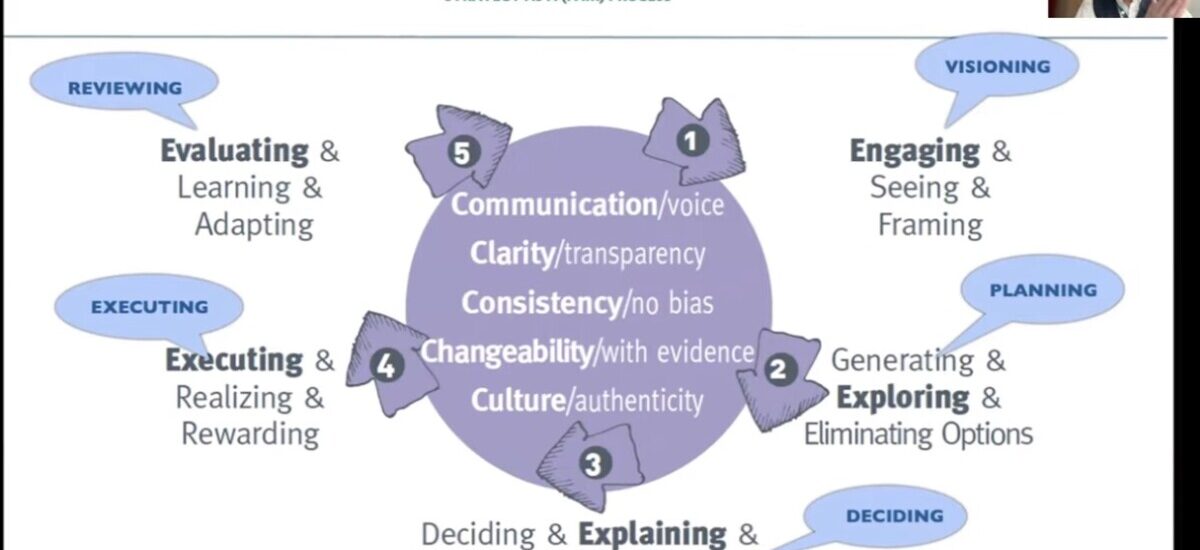
He introduced a five-step strategy helix — framing the challenge or opportunity, strategic planning, decision-making, execution, and evaluation and learning — and made a point that resonates far beyond the boardroom: most execution problems are not execution problems. They are failures of the first three steps, namely framing the battle, exploring the path to victory, and then deciding what defines victory and how it will be achieved. “Execution is only number four. Most execution problems are because you didn’t do one, two and three well — or you didn’t do five well, which is you didn’t learn from the past and failed to adapt the company for the present and future battles.”
His closing challenge was on the quality of board members themselves. Beyond competence, which he argued to be an obvious (who wants incompetent directors anyway?), boards need what he called “angels” — directors who see things that others don’t, who serve the corporate mission with their talent, insights, and also intuition, rather than imposing their own ideology regardless of the actual context. The opposite — what he called “idiots” — are not unintelligent people but people who impose their truth (often developed in earlier and different contexts) regardless of actual corporate reality. “An angel brings a truth that serves the corporation in its mission. An idiot imposes a truth that serves themselves and their overblown egos or insecurities.”

The Compounding Complexity of Board Agenda
Julie Baddeley, Chair of the Chapter Zero Alliance — a network of chapters in over 70 countries focused on equipping directors to tackle climate change from the boardroom — and co-founder of Chapter Zero UK, picked up Van der Heyden’s thread with a perspective drawn from 25 years of board experience.
“I have never experienced the complexity and number of competing issues for board attention that we have today,” she said. “It is just astonishing.” The practical implication for how boards operate is profound: preparation has taken on a whole new dimension. Papers arrive later. Agendas are more compressed. And the temptation — which she named directly — is to extrapolate from the status quo. “The status quo is not going to survive. The companies that thrive will have found ways of being resilient, adapting, and grabbing the opportunities for that future world.”
Her diagnosis of where boards most need to change was structural as much as cultural. The risks around climate, social issues, biodiversity, water and resources are not separate issues — they compound and amplify each other. Yet too many boards still treat them as siloed items, each addressed by a different committee, each assessed in isolation. “The good boards understand the interactions. An awful lot still don’t.”

Her prescription was concrete: committees need to roll their sleeves up. In her experience, having a dedicated ESG committee that spent hours examining sustainability topics — rather than ten minutes at the end of a board agenda — made a transformative difference when those topics came back to the full board. The nominations committee needs to put the right people in place to bring these insights. And the audit committee, she argued, has an underused role: assessing whether the assets on the balance sheet still hold their value in a world changing as fast as this one.
Guardians of Continuity: The Investor’s Perspective
Virginie Morgon, Founder and Managing Partner of Ardabelle Capital and former CEO of Eurazeo, brought the perspective of someone who has operated at the intersection of investment, board governance and strategic transformation — and who came to the session with a clear conviction about what the board’s role actually demands.
“My big conviction,” she said, “is how to bring stakeholders at the core of how you help a corporation achieve its success.” As board members, she argued, “we are guardians — and guardians have to make sure that the corporation stands on its feet.”
That framing — continuity of activity — was her central contribution to the session. In a world where, as she observed, “every other six months we’re going to enter into a new crisis” — whether war, logistics disruption, tariff shock or geopolitical instability — the question of whether a company has over-indexed on single sourcing for competitive efficiency, at the cost of resilience, is a board-level question. “Did we do a good enough job if we are too dependent?”
Her experience at L’Oréal’s audit committee during the company’s first CSRD reporting cycle was instructive — and ran counter to the narrative that regulatory disclosure is purely a compliance burden. “Publishing the CSRD report brought to the attention of the executive team a very strong, deep dive and better understanding of their risk.” She described herself as a “big defender of CSRD, especially on the environmental side,” precisely because the detailed measurement process — on climate, pollution and other environmental KPIs — is “way deeper than just a reporting exercise.”
Her governance prescription was to shift committees from reviewing results to examining processes. “Committees review results — financial results, KPIs, sustainability outputs. But if you go more into the processes — how did they reach those achievements? how is continuity of business ensured during the Middle East war or a tariff crisis? — that is where guardians can bring their expertise and help embed AI, innovation and sustainability at the core, rather than just reviewing the end result.”

Morgon also shared her firm’s recently published report, Greening the Arteries of Europe’s Economy: A New Framework for Building Supply Chain Resilience and Strategic Autonomy — a timely contribution that maps the intersection of supply chain resilience, green transition and European strategic autonomy that sat at the heart of the session’s broader themes. The report and accompanying slides are available to download directly from Ardabelle Capital:
📄 Greening the Arteries — Full Report
📊 Greening the Arteries — Slides
AI, Energy and the Triple Transition: The Blind Spot Boards Must Close
Marina Niforos, President of Climate Governance Initiative Greece, board director, and doctoral researcher at Johns Hopkins SAIS examining how AI-driven demand is reshaping energy infrastructure and associated costs, brought the session’s most forward-looking and data-rich perspective — and one that challenged the room to see a connection that most boards are currently missing.
Recent board surveys, she noted, show AI sitting at the top of board priority lists, followed by geopolitical risk and political tensions — with climate having been “relegated to fourth or fifth or further down the line.” She argued that this shift in priorities reveals a deeper misunderstanding of what AI is becoming: boards are still treating it overwhelmingly as a question of productivity and competitiveness, while its most consequential growth dynamic is now energy and infrastructure.
The numbers she put on the table were striking. Global data center electricity demand grew by 17% in 2025 and is expected to surge further in 2026 — with data centers alone potentially ranking the equivalent of the world’s fifth largest national electricity consumer. Hyperscalers are deploying $600 billion on data center infrastructure in 2026 alone. The question of who pays for the resulting grid infrastructure costs — and how those costs are allocated across rate payers, including industrial and commercial users — is becoming a live boardroom issue.
“AI is now becoming an energy question as much as a software question,” she said. And for boards, the risk of treating AI investment decisions and sustainability strategy as separate tracks — governed by separate committees, assessed by separate frameworks — is a structural blind spot. “When you look at a business decision on AI but don’t look at the repercussions on the pressures on electrification or sustainability, you’re probably not accounting for the full cost of that decision.”
Her proposed antidote was a dynamic, integrated risk map — one that captures all three dimensions of Europe’s triple transition simultaneously: green, digital and sovereignty. “If you expose yourself on one, what is the impact on the other? Can you, as a board, in one page explain how a decision in one transition is impacting the other two? If not, you’re probably thinking in silos.” She called for cross-committee mandates and intersecting responsibilities — for example, having the audit committee chair participate in sustainability committee discussions, or having technology and sustainability committees share explicit mandate overlap on energy and emissions implications of AI investment.

The Single Most Important Governance Shift
Liselotte Engstam put a direct question to each panelist: given the triple transition — green, digital and sovereignty — what is the single most important governance shift boards need to make?
Julie Baddeley’s answer was structural: get all committees looking across the piece, not just within their own remit. The audit committee should be assessing long-term value at risk. The nominations committee should be building boards capable of genuine cross-disciplinary challenge. And whatever committee oversees sustainability should be covering AI, water, resources and the full range of transition risks — not just carbon.
Virginie Morgon’s answer was process-focused: go deeper into how results are achieved, not just what they are. “If you go into the processes — how did a product get that market share using new technologies? how is continuity of business insured during a crisis? — that is where boards can bring their expertise and actually help embed AI, innovation and sustainability at the core.”
Marina Niforos’s answer was relational: cut the silos between committees. “Too many committees can signal that we’re not doing our job well. What we need is more process of interaction and collaboration between standing committees — so that sustainability considerations actually become about strategy, not compliance.”
What Participants Said: Live Poll Results
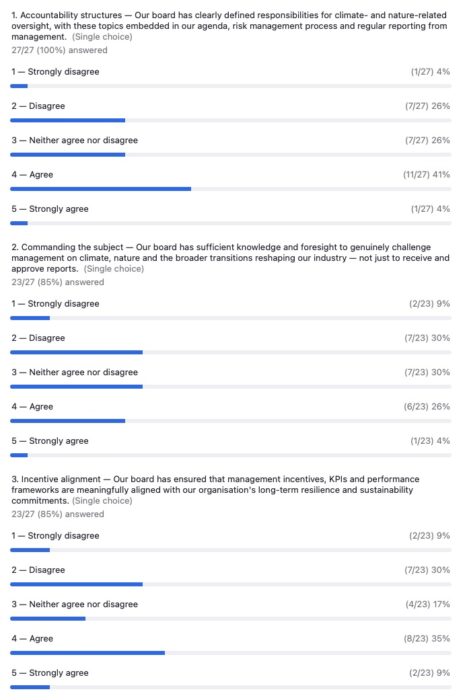
Three questions were put to participants, each mapped to the three foundations of effective board oversight:
Has your board defined clear accountability structures for the triple transition? Results were moderately positive — with almost half of participants feeling the structures are in place. Julie Baddeley offered a candid observation: this was a self-selected group of engaged board directors. “Having seen a similar survey a few months ago with a very different audience, the scores were much less positive.”
Does your board have sufficient command of the subjects — green, digital and sovereignty — to govern them effectively? Here the results were notably less confident, reflecting the genuine complexity of governing three interconnected, fast-moving transitions simultaneously.
Have incentives been aligned to support the triple transition? Results were divided — with the group splitting roughly equally between those who felt incentives were aligned and those who did not. This gap, the panel agreed, remains one of the most important and underaddressed governance challenges for European boards.
A Final Note: The Survey and Amsterdam
This webinar marked the end of the four-part series — but the project continues. Fernanda Torre and Liselotte Engstam closed the session with two calls to action.
First: please answer the European Board Survey, it is now live and open to all non-executive and supervisory board directors. Responses will form the first-of-its-kind European baseline on how boards are governing the intersection of sustainability, digital transformation and geopolitical change — and will feed directly into the Roadmap. As a thank you, every respondent will receive a complimentary digital copy of Leadership That Lasts: Building Sustainable Value in a Changing World, published by the Project Management Institute, which features a chapter co-authored by Liselotte Engstam and Fernanda Torre.
Second: remember to pre-register for the European Boards Growth & Resilience Forum which takes place in Amsterdam on 7 October 2026 — a full day of keynotes, working sessions and roundtables where board directors from across Europe will come together to stress-test and co-create the Roadmap itself. Applications are open now.
A collaborative initiative by Boards Impact Forum, Chapter Zero Netherlands, Chapter Zero France, Chapter Zero Brussels and Climate Governance Initiative Greece — part of the Chapter Zero Alliance.



Recent Comments