


September 25, 2025 | Hosted by Boards Impact Forum
TAs expectations around sustainability, AI, and stakeholder governance evolve, materiality is emerging as a strategic driver — not just a reporting requirement. On September 25, 2025, Boards Impact Forum hosted an engaging session exploring how boards can guide materiality assessments with insight and impact, integrate material issues into strategy, and strengthen decision-making across the enterprise.
The live discussion, moderated by Liselotte Engstam and Fernanda Torre, brought together two distinguished experts:
- Jane Thostrup Jagd, Director at the We Mean Business Coalition, Net Zero Finance, and member of several international sustainability standards and advisory groups.
- Frederik Otto, Consultant at AvS Advisors and Chair of The Sustainability Board Institute, with extensive experience advising boards globally on leadership, oversight, and governance for uncertain futures.
Table of Contents
Setting the Context: Boards and the Planetary Challenge
The session opened with reflections on the 2025 Planetary Health Check by the Potsdam Institute for Climate Impact Research, which reported that seven of the nine planetary boundaries have now been breached. This stark scientific finding underscored the urgency of integrating sustainability into core business strategy — and the critical role of boards in ensuring companies operate within planetary limits.
Building on the World Economic Forum’s eight Principles for Effective Climate Governance, the discussion focused on Principle 4 (Materiality Assessments) and Principle 7 (Reporting and Disclosure) — emphasizing how boards can move from compliance-oriented oversight toward strategic influence and value creation.
What Companies’ First CSRD Reports Reveal
Drawing on her analysis of the first Corporate Sustainability Reporting Directive (CSRD) Jane reports from the 100 largest listed EU companies, Jane shared practical insights into how leading organizations are implementing double materiality assessments and aligning sustainability with enterprise risk management.

Her research revealed that:
- Double materiality remains challenging — financial and impact materiality assessments are often disconnected from traditional financial risk management frameworks – partly driven by law. “Companies are still to report on gross risks within their double materiality, but uses net risks in their financial assessments,” Jane explained, “which creates inconsistencies between sustainability and financial reporting.”
- Data quality and comparability are improving. Nine out of ten companies restated or corrected previous data, showing that regulation and assurance are driving higher standards.
- Physical and transition risks are becoming strategic inputs. Companies like Maersk and Royal Dutch Shell are mapping physical climate risks across assets and operations, quantifying the potential financial impact of disruptions.
- Opportunity reporting is still rare, but examples are emerging. Air Liquide, for instance, has begun evaluating both risks and opportunities in its climate strategy, while others are even monetizing opportunities linked to the green transition.
- Detailed transition plans remain limited. While many firms have set net-zero targets, few specify the timing, levers, and quantified actions required to achieve them.
Jane’s closing note was a call to action: “Yes, regulation matters — but this is not just about compliance. It’s about credibility, comparability, and competitiveness. Better data allows investors and boards to link financial and sustainability performance — and that’s where strategic value is created.”
Boards at the Crossroads of Global Issues
Frederik Otto brought a governance and leadership lens, drawing from his international board advisory work. He urged directors to move beyond narrow definitions of sustainability and instead view it as “the essence of long-term capitalism — the ability to be maintained at a certain level.”

He proposed a useful acronym — CHANGE — summarizing the key domains that boards must oversee today:
- Climate
- Human rights
- AI and emerging technologies
- Nature and biodiversity
- Geopolitics and geoeconomics
- Equality
Frederik highlighted how ownership structures shape board approaches to these issues:
- Family-owned companies often embed sustainability into values-driven strategies, independent of external mandates.
- Private equity investors increasingly view ESG as a source of value creation, linking improved sustainability performance to higher exit valuations.
- Public companies face growing scrutiny from large institutional investors, whose stewardship guidelines explicitly define expectations for climate and nature governance.
He also revisited directors’ fiduciary duties, noting that while laws differ, none prevent boards from considering long-term environmental and social risks. The UK’s Section 172 and India’s Section 166(2) were highlighted as progressive models explicitly requiring boards to consider broader stakeholder interests.
Finally, Frederik emphasized scenario planning and horizon scanning as critical yet underdeveloped board capabilities. He encouraged directors to adopt contextual scenario methods — like the Oxford Scenario Planning Approach — to anticipate plausible futures and embed foresight into board deliberations. “It’s not just about compliance or strategy sessions once a year. Ask yourself: how are we applying this tactically? When and where are these discussions happening in the boardroom?”
Poll Insights and Participant Reflections
A live poll invited participants to reflect on their own board practices. Results revealed that:
- Few boards currently conduct structured horizon scanning to anticipate emerging risks.
- Most have transition plans, but not yet in a detailed, time-bound format.
- Very few quantify or monetize climate risks for decision-making.
These findings aligned with Jane’s data and Frederik’s observations: progress is visible, but integration into strategy and oversight remains uneven. Participants from across Europe and Asia added perspectives on ownership structures, regulatory contexts, and practical challenges — from balancing profitability with sustainability in circular economy models, to navigating cross-jurisdictional expectations in multinational boards.
Key Takeaways for Boards
- Materiality is strategic, not administrative. Boards should use materiality assessments to shape strategy and investment priorities, not just reports.
- Foresight builds resilience. Horizon scanning and contextual scenario planning are essential tools for anticipating disruption.
- Ownership matters. The board’s approach to sustainability depends heavily on who owns the company and how they define long-term value.
- Transparency drives trust. Better, comparable data allows investors and stakeholders to make informed judgments — and builds board credibility.
- The board chair sets the tone. Committed chairs and committees that integrate sustainability and AI oversight create momentum for transformation.
As Jane concluded, “This is not only about compliance — it’s an opportunity to get ahead of your peers.”
Learn More
At Boards Impact Forum, we remain committed to supporting NEDs in this evolving landscape, ensuring sustainability and governance go hand in hand.
Webinars, Peer Exchanges and Events
Check our upcoming events, all with NED Guest Speakers and Peer Exchange:
Board Programs
Sign up for our programs:
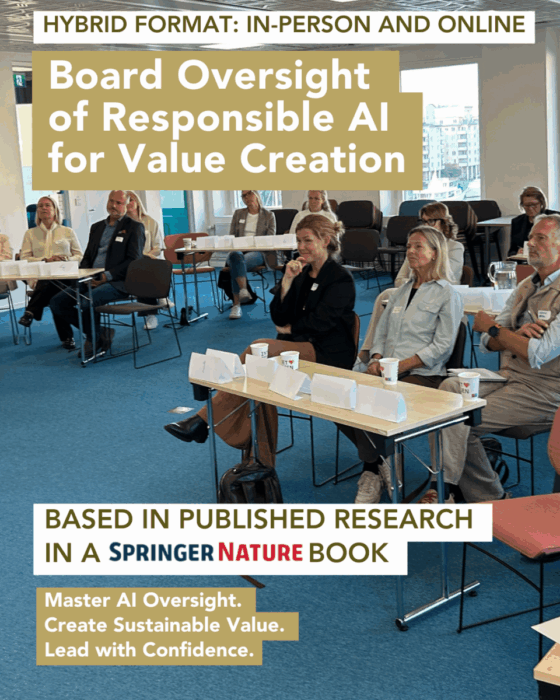
- NEW! Boards Oversight of Responsible AI for Value Creation – Hybrid format – EARLY BIRD NOW AVAILABLE
- Boards Oversight of Responsible AI
- Boards Oversight of Sustainability
Become a Member
Want to be part of the transition? Become a member of Boards Impact Forum and shape the future of governance.
About Boards Impact Forum and the blogpost
This blogpost is also shared at the blog of of Digoshen, www.digoshen.com.


Recent Comments