


On the morning of 23 April 2026, board directors and governance experts from across Europe gathered online for the second webinar in the European Boards Growth & Resilience Roadmap series — a cross-European initiative bringing together Boards Impact Forum, Chapter Zero Netherlands, Chapter Zero France, Chapter Zero Brussels and Climate Governance Initiative Greece to build a practical governance roadmap for European boards.
The session, moderated by Liselotte Engstam, Chair of Boards Impact Forum, focused on the Risk and Opportunity principle of the Chapter Zero Alliance governance framework — and on a central question that is reshaping boardroom conversations across the continent: how do boards move beyond defensive risk management toward proactive strategic positioning that generates genuine competitive advantage?
The answer that emerged over 90 minutes of keynote, panel discussion and live polling was both clear and challenging: the boards that will define Europe’s next decade are those that govern risk with ambition, not just caution — and that treat resilience not as a shield, but as a source of growth.
Table of Contents
The Context: Mixed Signals and a Shifting Narrative
Andreas Rasche, Professor of Business in Society and Associate Dean at Copenhagen Business School, opened the session with a keynote drawing on four years of research into sustainability governance — research that forms the basis of his forthcoming book, Sustainability in the Boardroom.
His starting point was the paradox facing European boards in 2026: a landscape of simultaneous push and pull forces that send contradictory signals. On one side, progress — the Clean Industrial Deal, the Industrial Accelerator Act, declining renewable energy prices, and sustained policy momentum. On the other, headwinds — the geopolitical shockwave of Russia’s invasion of Ukraine, which paved the way for a fossil fuel revival; an anti-ESG movement in the United States that has led some major companies to roll back sustainability targets; and a significant simplification of European reporting requirements that has dramatically reduced the number of firms legally obliged to report on sustainability.
“Prior to simplification, around 46,500 European firms were in scope for the CSRD,” Rasche noted. “That number has now dropped to roughly 4,800. The law is not there anymore. And the question is — why should we do this?”
His answer was clear: because sustainability is not retreating. It is being relabelled. Decarbonisation is now energy security. Circularity is now strategic raw material independence. The agenda is alive — but the narrative has shifted, and boards that still think in compliance terms risk missing it entirely.

Rasche identified three interconnected elements that boards need to build what he calls a “sustainability infrastructure”: the right governance structures, the right mindset, and the right competencies at individual director level. Of these, mindset is perhaps the most critical — and the hardest to shift. Most boards, he argued, still operate with a legal compliance mindset: reactive, risk-focused, and inadequate for the complexity of the moment. What is needed is a broader orientation — one that is forward-looking, strategically aware, and capable of identifying the opportunities hidden inside disruption.
Playing to Win, Not Playing Not to Lose
Marguerite Soeteman-Reijnen, non-executive director at Siemens Nederland and MN and former Chairman of Aon Holdings Netherlands, picked up this thread immediately. “A lot of companies are looking at sustainability as playing not to lose,” she observed. “I would rather define it as playing to win.”
That distinction, she argued, has profound implications for how boards structure their work. Playing to win requires forward-looking information — not just backward-looking reporting — drawn from both internal stakeholders such as works councils and external sources including NGOs and market intelligence. It requires the right committee structures and processes. And it requires a boardroom culture with an open mindset for critical questions.

Soeteman-Reijnen also introduced a framework for thinking about resilience that extended well beyond the corporate: individual resilience, societal resilience, business resilience, and defence resilience — a category that has risen sharply in relevance since the war in Ukraine. In a world where geopolitical fragmentation is accelerating, she argued, boards need to be both coordinated and agile: setting a clear strategic direction while remaining capable of rapid adaptation.
Her advice on managing crisis preparedness was characteristically direct: “Repair the roof when the sun is shining. If you don’t define your board’s position on something — whether you would pay a ransom in a cyberattack, for example — you will spend precious energy debating it in the middle of a crisis.” The same logic applies to a board’s moral compass: define your norms and values in calm times, so that when the winds blow — and they will — you are anchored.
Keep Your Eye on the Prize
Terence O’Rourke, Chair of ESB (Ireland’s state-owned Electricity Supply Board) and RTÉ, brought the perspective of a board leader navigating one of the most consequential transitions in European industry: the electrification of an entire national energy system.
ESB has committed to being net zero by 2040 — a target the board has debated seriously, and chosen to keep, even when the pathway beyond 2035 remains genuinely unclear. “We debated whether we should keep net zero even though it’s almost impossible to see how we get there,” O’Rourke said. “We said no — we will keep our eye on the prize. Because if we relax our ambition, we will never get there.”
The discipline O’Rourke described for separating structural shifts from short-term noise was practical and replicable: two dedicated board strategy sessions per year, entirely stripped of operational and financial reporting, focused purely on long-term strategic questions. Within those sessions, the board has experimented with structured debate techniques — assigning board members opposing positions on strategic issues, forcing even committed advocates for sustainability to argue against it. “A few things came out,” he noted. “Not hugely, which is good. We didn’t want to upend our strategy. But it was very useful.”
The board also maintains a rolling view of emerging risks — tracking potential threats that appear small on the horizon but tracking their movement year by year, as what he described as “incoming missiles.” And it makes purposeful investment in innovation, with a dedicated group continuously scanning technological developments — including, currently, small modular nuclear reactors — to stay ahead of what might become critical.

The Technology Dimension: Daring to Ask the Right Questions
Wendy Bor, supervisory board member at Ampleon and Geodelta with senior leadership experience at Shell, Ericsson, Suez and SAIC, brought the technology dimension into sharp focus. As AI reshapes industries and data ecosystems, she argued, the board’s role as steward of the process has never been more important — or more demanding.
“Data can think for itself now,” Bor observed, describing how AI is opening up entirely new ecosystems and value chains, including within her own boards. But with that opportunity comes complexity — and the risk of boards that are informed only by what management chooses to bring to them. “Around me, I see fellow board directors who just don’t rely on what they get from the management team. They create their own learning, their own information, to form an opinion. And I think that’s very useful.”

Her key call to action was cultural as much as structural: boards need to dare. There is a Dutch word, she noted — lef — that captures it. The courage to ask uncomfortable questions. To put capital allocation and value creation explicitly on the agenda alongside risk. To link sustainability not just to compliance or purpose, but to competitive positioning against China, against the United States, against a rapidly shifting global landscape.
In her own boards, strategy is no longer a once-a-year event. It appears in every board meeting — not as a full agenda item, but as dedicated time for discussion around two or three live dilemmas placed on the table by the chair. “It supports knowledge sharing, awareness sharing. We challenge ourselves.”
What Participants Said: Live Poll Results
Three questions were put to participants during the session:
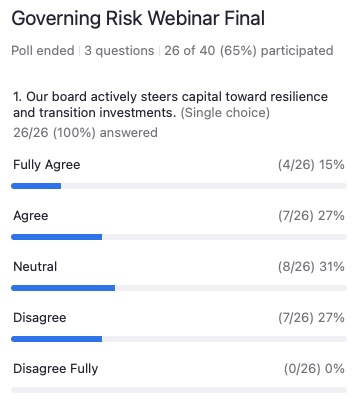
Does your board actively steer capital toward resilience and transition investments? Results were spread across the full range — reflecting, as Soeteman-Reijnen observed, the reality that companies are at very different stages of this journey. Some are already actively investing in transition; others are still finding their path.
Does your board treat resilience as a source of competitive advantage, not just a defense measure? Here the results were significantly more positive — with only 4% disagreeing, compared to 27% on the capital allocation question. O’Rourke’s reading: boards find it conceptually easier to see resilience as opportunity than to actually deploy capital toward it.
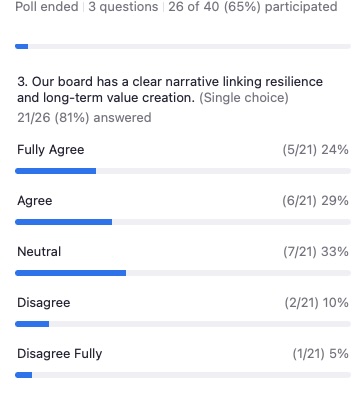
Does your board have a clear narrative linking resilience and long-term value creation? Wendy Bor was candid about her disappointment with the results here. “The score should be much higher,” she said. Resilience and long-term value creation are connected along multiple dimensions — brand and reputation, customer and market demand for sustainable products, and talent attraction from younger generations who actively choose employers based on their sustainability credentials. “Having that narrative is also about value creation and being a good company.”
The Dependencies Hiding in Plain Sight
One of the sharpest moments of the session came in the discussion of strategic dependencies — the supply chain, energy, technology and raw material exposures that many European boards have not yet fully mapped.
Andreas Rasche put two numbers on the table: Europe’s average dependency on fossil fuels remains at 57%. Its dependency on China for the rare earths and critical raw materials needed for the green transition exceeds 90%. “We have a double dependency,” he said — on the raw materials themselves, and on China’s manufacturing capacity for solar and wind technology. The last 20-25% of the decarbonisation journey, he warned, will be harder than most boards currently appreciate.
Soeteman-Reijnen issued a direct challenge to any board of a manufacturing company in the room: do you actually know where your critical raw materials come from? She described addressing a room of 300 legal counsels in the Netherlands, half of whom worked for companies that make physical products, and asking how many could describe their supply chain for critical materials. Three raised their hands. Her conclusion: the scenario testing that boards routinely apply to financial risks needs to be applied with equal rigour to supply chain and material dependencies — and it needs to happen before, not during, a crisis.
Looking Ahead
The insights gathered during this session will contribute directly to the European Boards Growth and Resilience Roadmap — a cross-European initiative aimed at translating governance principles into practical, actionable guidance for boards across Europe. The Roadmap will be workshopped and tested at a face-to-face forum in Amsterdam on 7 October 2026, and published in early 2027.
The third webinar in the series — Beyond Compliance: Making Disclosure a Board-Level Strategic Tool — took place on 28 May 2026.
A collaborative initiative by Boards Impact Forum, Chapter Zero Netherlands, Chapter Zero France, Chapter Zero Brussels and Climate Governance Initiative Greece — part of the Chapter Zero Alliance.


Recent Comments