


September 4, 2025 | Hosted by Boards Impact Forum
This event brought together board members, academics, and practitioners to explore how boards can lead with confidence in the age of AI, balancing innovation and governance while embracing uncertainty.
The session featured insights from:
- Mats Magnusson, Professor and Deputy Head at the School of Industrial Engineering and Management, KTH Royal Institute of Technology
- Henrik Forzelius, Executive and PhD researcher at KTH, with deep expertise in digital strategy and governance
- Tuomas Syrjänen, Co-founder and Chief AI Officer at Futurice, serving on multiple boards and leading AI-driven transformation programs
Moderation was led by Liselotte Engstam and Fernanda Torre of Boards Impact Forum.
Table of Contents
Navigating Disruption: Why AI Demands a Proactive Board
Mats Magnusson and Henrik Forzelius opened the session with research findings on how boards can handle different types of disruption.
- AI is not a typical disruption. Unlike abrupt shocks such as COVID-19 or geopolitical crises, AI is a gradual disruption—fast-moving, uncertain, and continuously evolving. This makes traditional governance approaches insufficient.
- Proactive boards perform better. Their research showed that boards engaging in foresight, experimentation, and continuous strategy reviews achieve stronger innovation and competitive outcomes.
- Independent foresight is critical. Boards cannot rely solely on management perspectives. Scenario planning, external benchmarking, and independent exploration help overcome biases and “functional fixness.”
As Magnusson noted, “AI is both a general-purpose technology and an invention that changes the way we invent. To capture its potential, boards must engage early, experiment, and lead with foresight.”

Forzelius added, “When facing AI, the biggest mistake a board can make is waiting for certainty. You must act before the tipping point—experiment, learn, and accept that failures are part of progress.”

From Exploration to Action: Board Practices for AI Oversight
The speakers emphasized that proactive governance requires:
- Iterative strategy work: replacing the traditional annual cycle with ongoing reviews and experimentation.
- Committees and agenda integration: ensuring AI and innovation are permanent boardroom items.
- Reframing risk: viewing inaction as the greatest risk, and treating failures as learning opportunities.
- Building trust and openness: enabling boards and management to collaborate in uncertainty.
Boards must move from monitoring to active experimentation—partnering with stakeholders, encouraging pilots, and embedding inclusiveness and openness into decision-making.
Guiding AI Adoption: Lessons from Practice
Tuomas Syrjänen brought the practitioner’s perspective, sharing how Futurice and other organizations are rethinking governance in AI transformation.
Key insights included:
- Boards should lead by example. Using AI tools for productivity (e.g., analyzing board materials) both improves discussions and signals commitment.
- Focus on business impact, not just technology. Real results come from redesigning processes—shortening cycle times, codifying compliance into technology, and shifting from reactive to proactive engagement with customers.
- Demand hard KPIs. Boards should look for visible business outcomes—such as reduced sales cycle times or increased proactive outreach—not just “time saved.”
- Encourage new paradigms. AI enables breaking long-standing trade-offs (e.g., being both globally efficient and locally adaptive). Boards should ensure management explores these possibilities.
- Support management in the journey. Transformation is challenging; boards must balance expectations with encouragement.
As Syrjänen stressed, “The biggest risk is bolting AI onto old processes. Boards must ensure organizations rethink paradigms, not just technology.”

Poll & Breakout Discussions
Participants reflected on their own boards’ AI readiness through a live poll. While many boards had linked AI to strategy, fewer felt confident about their actual progress—a gap highlighting the need for experimentation and clearer practices.
In breakout discussions, directors exchanged experiences on:
The importance of role modeling AI use within the board itself.y.
The shifts their boards need to become more future-ready.
How to encourage experimentation and knowledge-sharing across business areas.
Key Takeaways for Boards
- Embrace uncertainty. AI transformation cannot be solved with traditional governance tools—boards must explore, test, and adapt.
- Lead with foresight. Independent perspectives, scenario planning, and experimentation help boards see beyond management’s lens.
- Integrate AI into governance. Make AI a standing agenda item, with committees or task forces driving progress.
- Balance oversight with support. Boards must safeguard while enabling management to take calculated risks.
- Model the change. Directors who personally use AI tools set the tone for the organization.
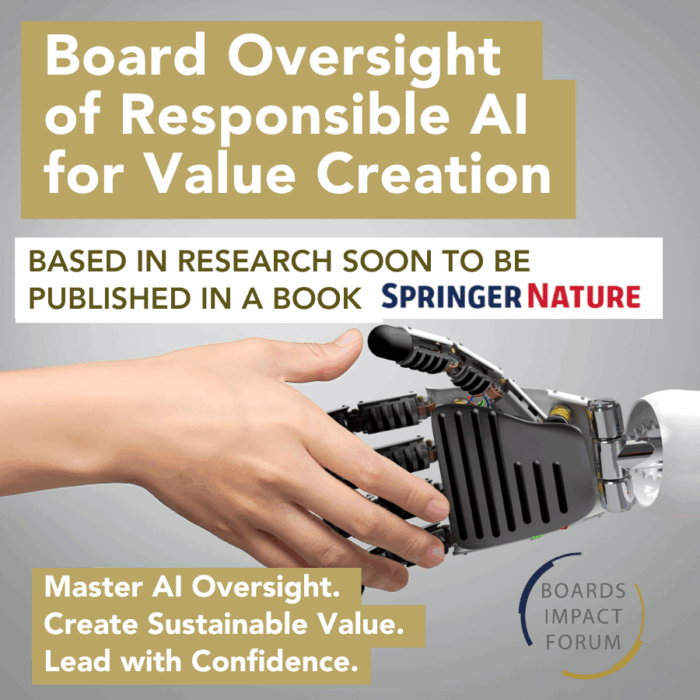
This webinar was held as an open session of the Boards Impact Forum AI Program, which equips boards with the knowledge, tools, and confidence to oversee AI responsibly and strategically. The program combines academic research, interactive boardroom simulations, and peer exchange to help directors lead with AI fluency.
👉 Learn more and register here to join upcoming sessions of the AI Program.
Learn More
At Boards Impact Forum, we remain committed to supporting NEDs in this evolving landscape, ensuring sustainability and governance go hand in hand.
Webinars, Peer Exchanges and Events
Check our upcoming events, all with NED Guest Speakers and Peer Exchange:
- 📌 September 25: Boards Role, Materiality, and Strategic Integration
Board Programs
Sign up for our programs:
- Boards Oversight of Responsible AI – Register until September 17!
- Boards Oversight of Sustainability

Become a Member
Want to be part of the transition? Become a member of Boards Impact Forum and shape the future of governance.
About Boards Impact Forum and the blogpost
This blogpost is also shared at the blog of of Digoshen, www.digoshen.com.



Recent Comments