

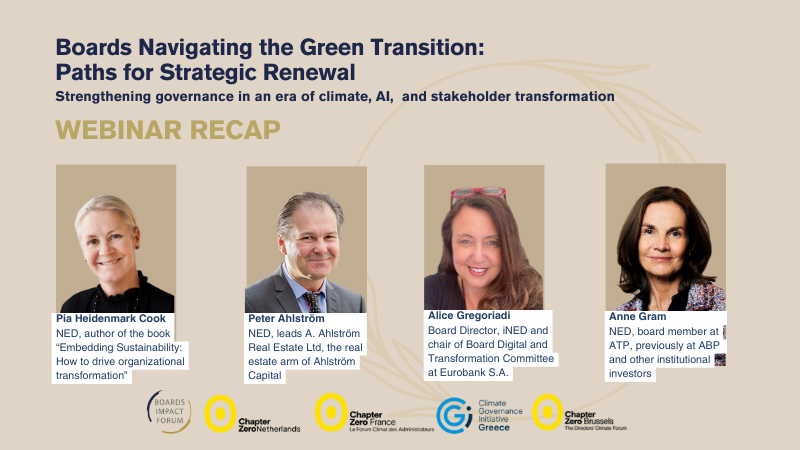
Strengthening board governance in an era of climate volatility, AI disruption, and stakeholder transformation
On 20 November 2025, Boards Impact Forum joined forces with Chapter Zero Netherlands, Chapter Zero France, Chapter Zero Brussels, and Climate Governance Initiative Greece, bringing together board directors and senior leaders from across Europe for a timely session exploring how boards can transform the green transition and AI shift into strategic renewal.
Moderated by Liselotte Engstam, Chair of Boards Impact Forum, and Fernanda Torre, Operations Director, the session combined thought-provoking perspectives with practical tools, peer exchange, and collective reflection.
Our distinguished speakers included:
- Pia Heidenmark Cook, experienced board director and former Chief Sustainability Officer at IKEA/Ingka Group
- Peter Ahlström, CEO of A. Ahlström Real Estate Ltd and fifth-generation family business owner
- Anne Gram, board member and investment professional in leading European pension funds
- Alice Gregoriadi, board director, digital transformation leader, and fintech advisor
Together, they unpacked how boards can move from risk awareness to true boardroom readiness, strengthening oversight while unlocking innovation and long-term competitiveness.
Table of Contents
Setting the Stage: From Legacy to Strategic Renewal
The session opened with a keynote from Peter Ahlström, drawing on his experience leading one of Finland’s oldest family companies, with seven generations committed to responsible value creation.
Peter underscored what long-term stewardship looks like in practice:
- A shared mission across owners and businesses – “A better world for future generations through sustainable value creation.”
- Deep integration of sustainability in investment decisions, with ESG due diligence preceding financial evaluation
- An evolving ESG maturity model, now expanded to six levels with a seventh underway
- Benchmarking across the portfolio, using traffic-light dashboards and peer comparisons to maintain accountability
- Use of the Upright Model, quantifying both positive and negative impacts to show true net value creation

His message was clear: boards must stay grounded in purpose while embracing new tools, transparency, and collaboration to guide companies through complexity.
What Risks and Opportunities Are Most Misunderstood Today?
The panel reflected on the shifting risk landscape and where boards often misjudge the moment.
1. The danger of information bias
Pia stressed that boards frequently operate with incomplete or distorted information.
Media narratives about “sustainability backlash” risk obscuring the reality that many companies are strengthening, not weakening, their climate commitments. Boards must take responsibility for diverse, high-quality information flows, not assume mainstream headlines represent the full picture.
2. Believing that inaction reduces risk
Anne noted a widespread misconception: that waiting will make things easier.
In fact, risks are compounding, and delayed action increases costs while shrinking opportunity space. Boards who wait risk losing strategic positioning entirely.
3. Treating climate and sustainability as standalone topics
Alice emphasized that fragmented governance is a major vulnerability. ESG cannot sit at the periphery; it must be embedded into risk frameworks, strategy, and digital transformation plans.
4. Underestimating the speed of interconnected risks
Peter reflected on the difficulty boards have aligning their mental models.
With geopolitics, climate, and AI accelerating simultaneously, boards must be willing to ask naïve questions, surface vulnerabilities, and build shared understanding.

Strengthening Oversight of Interconnected Risks
Embed sustainability into core governance, not the sidelines
Alice shared concrete examples from financial services:
- AI-enabled climate scenario modelling
- Real-time ESG monitoring
- Integrated risk and strategy dashboards
Embedding sustainability and digital competence into board composition, committee mandates, and decision processes is no longer optional.
Invest in joint learning for boards and management
Peter and Anne highlighted that boards often have uneven knowledge. The most efficient remedy?
Collective education.
When boards and management learn together, alignment accelerates dramatically.
Reclaim time on the agenda for strategy
All panelists underlined this: too many boards spend their time on reporting and backwards-looking oversight.
Strategic discussion must be designed into the agenda, not squeezed in at the margins.

Unlocking Opportunity Thinking: Innovation as a Governance Imperative
While risk is often the entry point, opportunity is where transformation happens.
Courage + agility = competitive advantage
Pia described how IKEA entered the solar energy market, a move that required:
- A bold long-term vision
- Permission to experiment
- Processes that allow teams to fail fast
- Board support for innovation that goes beyond core products
But she noted a concerning trend: boards today are less engaged on sustainability innovation than a few years ago, in part due to regulatory overload. Without intentional effort, compliance crowds out creativity.
Mobilise the entire ecosystem
Alice stressed the catalytic role organisations can play:
- Transition finance
- Green product portfolios
- Supply chain engagement
- Digital tools that unlock resource efficiency
Banks, in particular, can move entire sectors by rewarding transition performance.

Practices That Help Boards Move from Reactive to Proactive
As AI reshapes industries and sustainability imperatives intensify, boards have a pivotal role in steering both responsibly. The session highlighted that long-term value will come not from technology itself, but from how boards guide its purpose, integration, and impact.
Across the panel, several best practices emerged:
1. Rebalance board agendas
Shift from operational reporting to strategic dialogue.
Annual strategy days, off-site and disruption-free, help boards think beyond the quarterly cycle.
2. Foster diversity of thought
Boards need more than demographic diversity; they need cognitive, professional, and experiential diversity to avoid groupthink.
3. Strengthen psychological safety
Peter highlighted how informal time together increases trust, enabling board members to ask difficult questions and challenge assumptions constructively.
4. Coach management through transition uncertainty
Boards must balance support with challenge, encouraging ambition while fostering realistic, accountable pathways.
Boards Impact Forum will continue facilitating these vital discussions to equip Nordic boards with the insights and frameworks needed to lead through the era of AI-driven sustainable transformation.
What Did Participants Say? Poll Insights
Three live polls captured the state of readiness among attendees:
1. Clear transition plans
About half have established goals and plans for the green transition, while the other half are still in early stages.
2. Identifying opportunity
Fewer boards are systematically exploring opportunities from climate and AI shifts, indicating untapped potential.
3. Strategic workforce planning for AI
A large majority have not yet assessed how AI transforms talent and skills, despite new obligations under the EU AI Act.
Boards will need to play a more active role in ensuring organisation-wide AI training and oversight.
Final Recommendations from the Panel
Each panelist shared one priority recommendation for board members for the next three years:
1. Stay agile and lean in – Pia Heidenmark Cook
The world will not return to “normal.” Boards must embrace experimentation, learn fast, and act amid uncertainty.
2. Adopt a systems-level mindset – Anne Gram
Boards must integrate outside-in risks and inside-out impacts, both are critical to long-term value creation.
3. Use new tools and forward-looking analysis – Peter Ahlström
Boards should embrace modern impact tools, data models, and benchmarking to guide transition pathways.
4. Co-design climate and digital strategies – Alice Gregoriadi
Digital transformation and climate transformation must be designed together; neither succeeds in isolation.
Ready to lead your board through the AI and green transition?
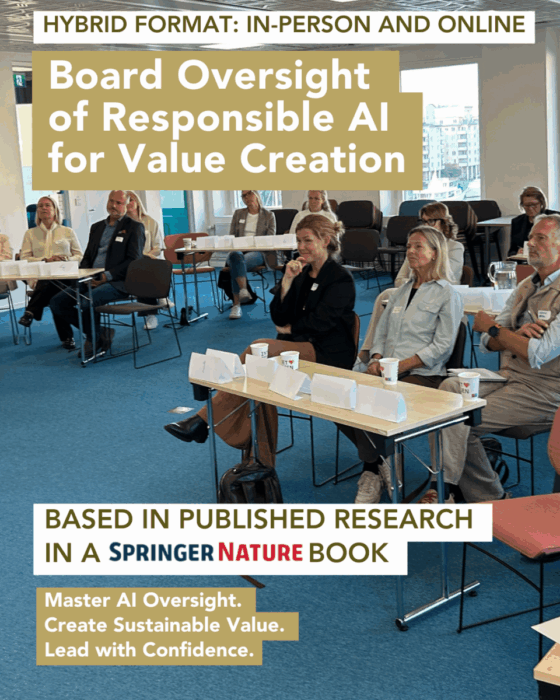
Join our Boards Oversight of Responsible AI for Value Creation program and gain the tools, frameworks, and peer insights to turn disruption into strategic advantage. Register today and future-proof your board’s impact.
Learn More
At Boards Impact Forum, we remain committed to supporting NEDs in this evolving landscape, ensuring sustainability and governance go hand in hand
Board Programs
Sign up for our programs:
- Boards Oversight of Responsible AI for Value Creation – Hybrid format – REGISTRATIONS OPEN
- Boards Oversight of Responsible AI
- Boards Oversight of Sustainability
Become a Member
Want to be part of the transition? Become a member of Boards Impact Forum and shape the future of governance.
About Boards Impact Forum and the blogpost
This blogpost is also shared at the blog of of Digoshen, www.digoshen.com.

Recent Comments